

Aluminum Grades Compared: How to Choose the Right Alloy for Your Part
- Aluminum grades at a glance
- What do the 1xxx to 8xxx aluminum series mean?
- 6061 vs. 6063 aluminum: Which should you choose?
- Aluminum temper designations explained
- Which aluminum grades work best for your application?
- Which aluminum grades are best for bending sheet metal?
- When should you choose 6061 or 7075 for CNC machining?
- Why is 6063 used for anodized window frames?
- When should you use 5052 or 5083 in marine equipment?
- Aluminum vs. stainless steel, galvanized steel, and uPVC
- How to verify aluminum grade, temper, and recycled content
- Frequently asked questions about aluminum grades
- Can 6061-T6 aluminum be bent to 90 degrees?
- Do all aluminum grades look the same after anodizing?
- Does aluminum rust outdoors?
- Why do quotes for similar aluminum profiles differ?
- Request a Quote for Custom Aluminum Parts
The easiest way to compare aluminum alloy grades is to start with the part you need to make. Choose 5052-H32 for a folded sheet metal cover, consider 6061-T651 for a fixture machined from plate, and look at 6063 for an anodized window frame. For a compact part that carries a heavy load, compare 7075 with 6061 to see whether the extra strength justifies the cost.
The easiest way to compare aluminum alloy grades is to start with the part you need to make. A folded sheet metal cover needs a material that bends cleanly, such as 5052-H32. A fixture milled from plate is a good candidate for 6061-T651.
For a window frame with narrow channels and a visible anodized surface, 6063 is often the better choice. Each example comes down to three questions: How will the part be made? What loads will it carry? What finish does it need?.
Aluminum grades at a glance
| If you are making… | Start with | Why it fits |
|---|---|---|
| A folded cover, enclosure, or sheet metal bracket | 5052-H32 sheet | Bends well and offers good corrosion resistance |
| A machined mounting block or spacer | 6061-T6 bar | Machines well and provides a useful balance of strength and corrosion resistance |
| A fixture plate with pockets or close flatness tolerances | 6061-T651 plate | Stress relief reduces the risk of movement during machining |
| A window frame, trim section, or display profile | 6063 extrusion | Suits detailed cross-sections and decorative anodizing |
| A welded marine plate assembly | 5083 in the specified marine temper | Combines strength, weldability, and resistance to seawater exposure |
| A compact, highly loaded machined component | 7075-T6 | Offers higher strength than 6061 where the part has limited room to grow |
Use the table to shortlist a material. On the drawing or purchase order, specify the alloy, temper, and product form together. “6061-T651 plate” tells a supplier considerably more than "aluminum".
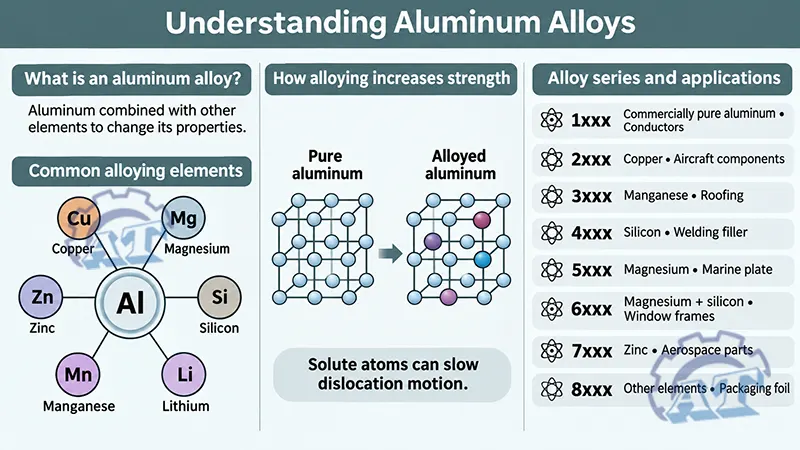
Common aluminum alloying elements and typical applications of wrought aluminum grades from 1xxx to 8xxx.
What do the 1xxx to 8xxx aluminum series mean?
The first digit in a wrought aluminum designation identifies the alloy family. For example, 5052 and 5083 belong to the magnesium-bearing 5xxx series. The remaining digits identify the individual grade.
A higher grade number does not indicate better quality or greater strength. This four-digit system applies to wrought products such as sheet, plate, bar, and extrusions. Cast alloys use a separate designation system.
| Series | Main alloying element or defining feature | Example grades | Common applications |
|---|---|---|---|
| 1xxx | At least 99% aluminum | 1050, 1100 | Electrical components, foil, and formed sheet |
| 2xxx | Copper | 2024 | High-strength aircraft components |
| 3xxx | Manganese | 3003, 3105 | Cookware, roofing, gutters, and formed panels |
| 4xxx | Silicon | 4043 | Welding filler and brazing materials |
| 5xxx | Magnesium | 5052, 5083 | Sheet metal enclosures, welded tanks, and marine plate |
| 6xxx | Magnesium and silicon | 6061, 6063 | Machined parts, structural tubing, and window profiles |
| 7xxx | Zinc | 7075 | High-strength machined and aerospace components |
| 8xxx | Other alloying elements | 8011 | Packaging foil and specialized products |
The series tells you which grades are worth investigating. The individual alloy and temper determine whether a particular sheet will take a tight bend or a particular extrusion will meet the strength requirement on the drawing.
6061 vs. 6063 aluminum: Which should you choose?
Choose 6061 for machined brackets, mounting blocks, and frames that need higher strength. Choose 6063 for detailed extrusions, especially when the finished surface will be visible. Both alloys can be extruded and anodized. The difference is which properties matter most to the part.
| Property | 6061 aluminum | 6063 aluminum |
|---|---|---|
| Strength | Generally higher at comparable tempers | Suitable for many architectural and moderately loaded sections |
| Machining | Well suited to milling, drilling, and tapping | Suitable for cutting, drilling, and machining features into profiles |
| Extrusion | Common in structural shapes, bars, and tubes | Well suited to profiles with grooves, channels, and detailed cross-sections |
| Finish | Can be anodized or powder-coated | A common choice for a uniform decorative anodized finish |
| Typical part | A mounting block with tapped holes | A window frame with glazing channels and exposed faces |
When comparing extrusion quotes, check the cross-section, wall thickness, temper, and weight per meter. Two profiles with the same outside dimensions can contain different amounts of metal. For an architectural finish, identify the faces that will remain visible after installation and agree on a finish sample before production.
Aluminum temper designations explained
The suffix after the alloy number tells you how the material was processed. It matters as much as the grade in operations such as bending and milling. For example, 6061-T4 and 6061-T6 have the same alloy chemistry, but T4 generally allows more forming before cracking.
| Temper | What it means | What it means for the part |
|---|---|---|
| O | Annealed | A soft condition suited to substantial forming. The symbol is the letter O. |
| H32 | Strain-hardened and stabilized to a quarter-hard temper | Common in 5052 sheet used for bent panels and enclosures |
| T4 | Solution heat-treated and naturally aged | Useful when a heat-treatable alloy needs to be formed |
| T5 | Cooled after hot forming and then artificially aged | Common in architectural extrusions such as 6063 profiles |
| T6 | Solution heat-treated and artificially aged | Common in machined 6061 parts that need strength |
| T651 | Solution heat-treated, stress-relieved by stretching, and artificially aged | Useful for plate that will undergo substantial machining |
Consider a fixture with a deep pocket on one face. As the cutter removes material, residual stress can cause the plate to bow. Starting with 6061-T651 reduces that risk. The drawing still needs a finished flatness tolerance so the machinist knows what the fixture must meet after it comes off the machine.
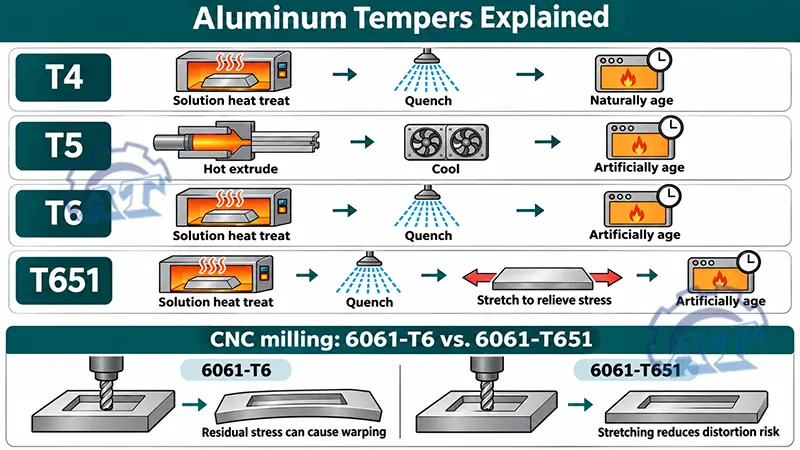
Aluminum tempers T4, T5, T6, and T651, showing how stress relief reduces the risk of warping when CNC milling 6061-T651 plate
Which aluminum grades work best for your application?
Which aluminum grades are best for bending sheet metal?
5052-H32 is a practical starting point for bent covers, electrical enclosures, and sheet metal brackets. When specifying a bend, give the fabricator both the angle and the inside bend radius. A 90-degree flange with a generous radius is easier to form than a sharp 90-degree corner in sheet of the same thickness. Recommended minimum radii also depend on temper, sheet thickness, and bend orientation relative to the rolling direction.
When should you choose 6061 or 7075 for CNC machining?
Choose 6061 for general-purpose fixtures, mounting plates, and spacers. Consider 7075 when the design needs greater strength within a fixed size or weight limit. A useful question is what prevents the part from meeting its requirement. If a thin bracket yields under load, a stronger alloy may help. If the difficulty is holding a flat mounting face after milling, stress-relieved stock and the machining sequence deserve attention first.
If the assembly will be welded, review that requirement before finalizing the alloy. Welding can reduce the strength of 6061-T6 near the joint, so the design needs to account for the properties of the welded assembly.
Why is 6063 used for anodized window frames?
A window profile often combines a glazing channel, a groove for a seal, and a broad face that remains visible after installation. 6063 suits this combination of detailed geometry and decorative finish. When adjacent pieces must match, specify the color and surface preparation and approve a sample under the lighting in which the finished frame will be seen
When should you use 5052 or 5083 in marine equipment?
5052 is useful for formed covers and panels exposed to salt spray. 5083 is widely used for welded marine plate, including hull structures. Tell the supplier whether the component will sit above deck, face intermittent splash, or remain in contact with seawater. For a structural marine part, use the grade, temper, and product specification called for by the design.
Aluminum vs. stainless steel, galvanized steel, and uPVC
| Material | When to consider it | What to compare in the quote |
|---|---|---|
| Aluminum | Weight matters, the part has a detailed extruded profile, or several faces require machining | Alloy, temper, section dimensions, and surface finish |
| Stainless steel | The part needs greater stiffness within a fixed envelope or must withstand higher operating temperatures | Stainless grade, service environment, and finished weight |
| Galvanized steel | Cost is a priority for a frame or support and additional weight is acceptable | Coating specification and protection at cuts and welds |
| uPVC | Thermal insulation is a priority in a window or door assembly | Reinforcement, glazing, seals, and tested performance of the complete system |
For equal volumes, aluminum weighs roughly one-third as much as steel. A frame redesigned in aluminum may need a larger cross-section to meet the same stiffness requirement. Compare the weight and price of the finished assemblies to see what the material change actually achieves.
How to verify aluminum grade, temper, and recycled content
Ask for a mill test certificate when the grade or temper is a purchasing requirement. Match the alloy, temper, and lot identification on the certificate to the delivered material. Check the reported chemistry against the limits for that alloy and the mechanical properties against the applicable product specification. A single iron-content limit cannot establish quality across every aluminum grade.
Recycled content and material quality answer different purchasing questions. Recycled aluminum is already used in commercial structural extrusions with documented material traceability. If the project also has a carbon target, request a product-specific Environmental Product Declaration (EPD). Compare suppliers using the same unit of measurement and the same production stages.
Explore our CNC machining services.
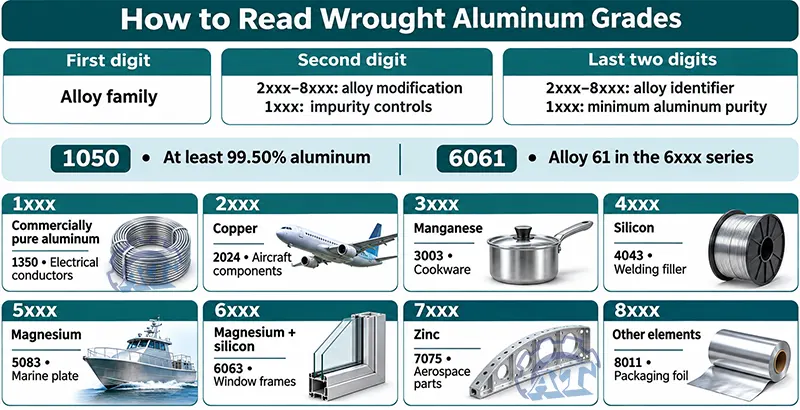
How to read four-digit aluminum grades, with 1050 and 6061 examples and typical uses for each series from 1xxx to 8xxx
Frequently asked questions about aluminum grades
Can 6061-T6 aluminum be bent to 90 degrees?
Yes, provided the inside radius is suitable for the sheet thickness, grain direction, and tooling. A tight radius increases the risk of cracking along the outside of the bend. If the drawing allows a material change, 5052-H32 is often easier to form.
Do all aluminum grades look the same after anodizing?
No. Alloy composition and surface preparation affect the finished appearance. For visible trim, 6063 is a common choice. If the part must match an existing component, give the finisher a physical sample and approve a production sample made from the specified alloy.
Does aluminum rust outdoors?
Aluminum develops a thin protective oxide layer when exposed to air. It can still corrode, particularly where salt and moisture collect. Pitting or white deposits are possible signs of corrosion. The alloy, finish, and drainage details all matter for outdoor components.
Why do quotes for similar aluminum profiles differ?
Check the wall thickness and weight per meter first. Then compare the alloy, temper, finish, and machining included in each quote. For complete doors or windows, glazing, hardware, and seals can also account for a substantial difference in price.
Request a Quote for Custom Aluminum Parts
custom machining and sheet metal fabrication for parts made to your drawings. To request a quote, send us your drawing, the quantity you need, and a brief description of how the part will be used. If you’ve selected a material, specify the aluminum grade, temper, and stock form, such as sheet, plate, or bar.
Related News

27/11
2026
In the field of cargo securing, transportation, and load restraint, J hooks, U hooks, and S hooks are among the most commonly used accessories. Each type of hook features a distinct design, construction, and range of applications, making it suitable for different operational requirements.
So, what are the differences between J hooks, U hooks, and S hooks? Which type offers the highest load-bearing capacity? And when should each type of hook be used?

25/11
2026
For stainless steel laser cutting, send a 1:1 scale DXF file for machine programming along with a dimensioned PDF to prevent cutting errors. Review the DXF, DWG, and PDF comparison chart, 3 shop-ready file export rules, and 5 common CAD mistakes to avoid.

17/11
2026
In laser metal cutting, product accuracy depends not only on machine power and cutting speed but also on various other technical parameters. One of the key factors that is often discussed is Kerf Width, which refers to the width of the cut produced by the laser.
What is kerf width? Why does it affect machining quality? And how can this parameter be controlled to minimize dimensional deviations and optimize production efficiency? Let's explore these questions in the following article.

14/11
2026
Mechanical engineering manufacturing is one of the fundamental engineering disciplines driving the development of modern industry. Almost every product and piece of equipment used in manufacturing, from industrial machinery and automotive components to agricultural equipment and everyday consumer goods, relies on mechanical manufacturing technologies at some stage of its production.
View more