

What Is a Screw Thread? 5 Core Uses, Types, Standards, and Selection Guide
- What Is a Screw Thread and How Is It Manufactured?
- 3 Industrial Methods for Creating Screw Threads
- How Thread Standardization Evolved from Whitworth to ISO
- What Are Screw Threads Used For? 5 Core Mechanical Functions
- 1. Fastening and Detachable Mechanical Joints
- 2. Mechanical Power Transmission (Lead Screws and Jacks)
- 3. Pressure-Tight Sealing in Piping Systems
- 4. Precision Positioning and Adjustment
- 5. Structural Safety in Construction
- Screw Thread Anatomy: Key Technical Parameters You Must Know
- Thread Profiles and Flank Angles
- Pitch, Number of Starts, and Thread Handedness
- Major, Pitch, and Minor Diameters Explained
- Common Types of Screw Threads in Engineering and Construction
- ISO Metric Threads (M)
- Trapezoidal (Tr) and Square Power Threads
- Pipe Threads: G, R, NPT, and BSP Standards
- Internal vs. External Threads: When to Use Each
- How to Choose the Right Screw Thread for Your Application
- Coarse vs. Fine Pitch Threads for General Fastening
- Selecting Threads for High-Vibration Environments
- Tapered vs. Parallel Pipe Threads for Fluid Systems
- How to Read Screw Thread Designations and International Standards
- Standard ISO Metric Thread Reference Table
- Decoding Thread Callouts on Engineering Drawings
- Comparing ISO Metric, Unified (UNC/UNF), and BSP Standards
- Common Screw Thread Failures and How to Fix Them
- Stripped Threads: Root Causes and Repair Options
- Chipped or Cracked Threads: When to Replace Immediately
- Seized and Rusted Threads: Safe Removal Procedure
- Frequently Asked Questions About Screw Threads
A screw thread is a continuous helical ridge that converts rotational motion into linear clamping force, power transmission, or pressure-tight sealing. Picking the wrong pitch or standard leads to stripped joints and costly leaks. Below is a practical breakdown of thread types, ISO and pipe standards, and how to specify the right fit.
A screw thread is a continuous helical ridge that converts rotation into clamping force, linear motion, or a pressure-tight seal. Picking the wrong pitch or standard leads straight to stripped holes, loose joints, and leaking pipes. Here is a practical breakdown of thread types, ISO and pipe standards, and how to specify the right fit on the shop floor.
What Is a Screw Thread and How Is It Manufactured?
A screw thread is a uniform helical ridge cut or formed around a cylinder (straight) or cone (tapered). External threads sit on bolts and shafts, while internal threads sit inside nuts or tapped holes. Mated together, they generate strong axial force through simple mechanical advantage.
3 Industrial Methods for Creating Screw Threads
Shops produce threads in three main ways, depending on batch size and strength needs:
-
Thread Turning: A single-point lathe tool cuts the profile. It delivers tight concentricity for custom shafts and small runs.
-
Tapping and Die Cutting: Taps cut internal holes; dies cut external rods. It is the go-to method for general fabrication and repair work.
-
Thread Rolling: Hardened dies cold-form the metal without cutting chips. Because rolling compresses the grain instead of slicing fibers, rolled bolts handle fatigue far better in mass production.
How Thread Standardization Evolved from Whitworth to ISO
Archimedes used the screw principle to lift water over 2,000 years ago, but standardized metal threads only began in 1841 with Joseph Whitworth's 55° profile. In 1947, ISO unified the global 60° metric system. Today, DIN, JIS, and TCVN align with ISO metric standards so parts from different countries bolt together cleanly.
What Are Screw Threads Used For? 5 Core Mechanical Functions
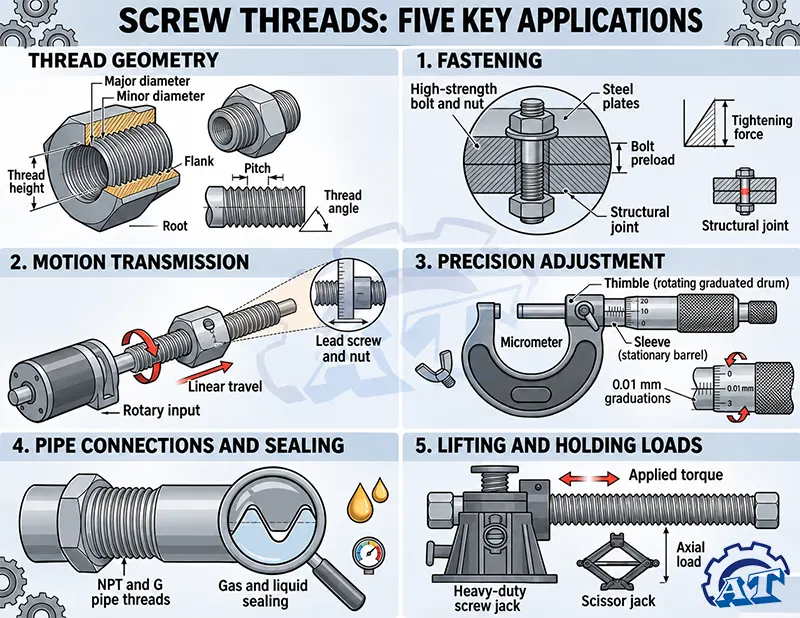
Screw threads handle five essential jobs in engineering: detachable fastening, power transmission, fluid sealing, micro-positioning, and structural anchoring. Each job requires a distinct profile and pitch so the joint holds under load without seizing or backing off.
1. Fastening and Detachable Mechanical Joints
Bolts, nuts, and studs hold assemblies together while allowing teardown for maintenance. Unlike welding, you can dial in exact clamping force with a torque wrench—like torquing automotive cylinder head bolts to 85 N·m so the gasket seals evenly.
2. Mechanical Power Transmission (Lead Screws and Jacks)
Trapezoidal (Tr) and square threads turn rotary torque into heavy linear thrust. You will see them driving lathe carriages, scissor jacks, manual presses, and industrial screw extruders.
3. Pressure-Tight Sealing in Piping Systems
Pipe threads contain water, air, steam, and hydraulic oil in two ways:
-
Tapered (NPT, R/Rp): The cone wedges tight as you wrench it down, sealing air and oil lines.
-
Parallel (G/BSPP): Straight walls rely on O-rings, bonded washers, or sealant to stop leaks.
4. Precision Positioning and Adjustment
Fine-pitch threads control movement down to fractions of a millimeter. One full turn of a 0.5 mm pitch micrometer spindle advances exactly 0.5 mm, making accurate measurement and valve calibration possible.
5. Structural Safety in Construction
Threaded rods and anchor bolts hang HVAC runs, tie scaffolding, and anchor steel columns to concrete. Bolt grades (4.6, 8.8, 10.9) tell you the exact tensile load each fastener can safely carry.
Screw thread anatomy showing major diameter, minor diameter, pitch, and flank angle
Screw Thread Anatomy: Key Technical Parameters You Must Know
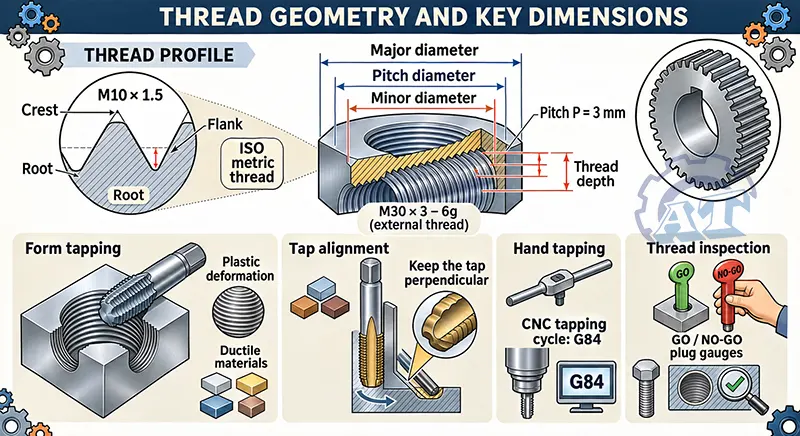
Every thread is defined by three things: its profile (cross-section), its pitch and handedness, and its three diameters (major, pitch, and minor). Miss just one measurement and parts will bind or strip under load.
Thread Profiles and Flank Angles
The profile shape decides how much friction a thread creates and which direction it carries load:
| Profile | Flank Angle | Best Trait | Main Use |
| Triangular (V) | 60° (ISO/UN) / 55° (BSP) | High friction, self-locking | Standard bolts, nuts, screws |
| Trapezoidal (Tr/Acme) | 30° / 29° | Strong axial load, low wear | Lead screws, machine vices |
| Square | 0° | Peak transmission efficiency | Heavy jacks, screw presses |
| Buttress | 3° / 45° | Extreme one-way thrust | Heavy clamps, hydraulic presses |
| Knuckle (Round) | Rounded | Resists dirt and chipping | Bottle caps, rail couplings |
Cross-sectional comparison of triangular, trapezoidal, square, buttress, and round screw thread profiles
Pitch, Number of Starts, and Thread Handedness
-
Pitch (P): Distance between two adjacent crests. Coarse threads assemble fast; fine threads resist vibration and adjust accurately.
-
Starts (n): Number of parallel ridges. Single-start is standard; multi-start (2–3 starts) opens and closes fast on camera lenses and bottle caps.
-
Handedness: Right-hand (RH) tightens clockwise. Left-hand (LH) tightens counterclockwise so rotating shafts - like left bike pedals or grinder arbors - do not spin themselves loose.
Major, Pitch, and Minor Diameters Explained
-
Major Diameter: Largest crest-to-crest diameter. It sets the nominal size (e.g., 10 mm for M10).
-
Minor Diameter: Smallest root-to-root diameter. It determines the core strength against snapping.
-
Pitch Diameter: The midpoint where ridge width equals groove width. This is where mating threads actually carry the load.
Common Types of Screw Threads in Engineering and Construction
Most shop drawings call out one of three families: ISO Metric (M) for fastening, Trapezoidal (Tr) for power transmission, or Pipe Threads (NPT, BSP) for pressurized lines.
ISO Metric Threads (M)
ISO Metric uses a 60° profile measured in millimeters and dominates global manufacturing. Coarse pitch is the default (M12), while fine pitch is always written out (M12 x 1.25).
Trapezoidal (Tr) and Square Power Threads
Standard V-threads wear out fast under heavy sliding loads. Engineers specify 30° ISO Trapezoidal (Tr) threads because they balance efficiency with thick roots and work with split nuts to take up backlash. Square threads run slightly smoother but cost more to machine.
Pipe Threads: G, R, NPT, and BSP Standards
Pipe sizes refer to nominal bore, not outside diameter:
-
NPT (American): 60° angle with a 1:16 taper, standard in North American oil, gas, and air lines.
-
BSP (British/ISO): 55° angle, split into tapered BSPT (R/Rp) and parallel BSPP (G).
Shop Floor Warning: Never force NPT into BSPT. The 60° vs. 55° angles and mismatched pitches will bite on the first two turns, then leak under pressure.
Tapered NPT pipe thread compared with parallel BSP thread sealing mechanism
Internal vs. External Threads: When to Use Each
Put external threads on replaceable hardware like bolts and studs; put internal threads in housings and plates. When tapping soft metals like aluminum, go deeper (1.5x to 2x diameter) or install steel inserts so the threads do not pull out.
Need custom-turned shafts or tapped assemblies? Check out our Precision CNC Mechanical Machining Services at An Thanh Tech.
How to Choose the Right Screw Thread for Your Application
Good thread selection comes down to three practical trade-offs: coarse vs. fine pitch, vibration locking, and tapered vs. parallel sealing. Match the thread to the working environment, not just what is sitting in the parts bin.
Coarse vs. Fine Pitch Threads for General Fastening
| Factor | Coarse (e.g., M10 x 1.5) | Fine (e.g., M10 x 1.25) |
| Assembly Speed | Faster; harder to cross-thread | Slower; needs careful alignment |
| Soft Metals (Aluminum) | Stronger strip resistance | Strips more easily |
| Tensile Strength | Standard | Higher (larger stress area) |
| Vibration Resistance | Lower | Better (shallower helix angle) |
| Dirty/Corrosive Sites | Handles nicks and rust well | Jams easily from debris |
Selecting Threads for High-Vibration Environments
Engines, screens, and trailers shake standard nuts loose fast. Start with a fine-pitch thread to lower the helix angle, then back it up with real locking hardware - Nord-Lock washers, nylon-insert nuts, or threadlocker. Never rely on torque alone.
Tapered vs. Parallel Pipe Threads for Fluid Systems
Use tapered threads (NPT/BSPT) for compact pneumatic lines and fixed plumbing -always add PTFE tape or pipe dope to lubricate the metal and seal spiral gaps. Use parallel threads (BSPP/G) with O-rings or bonded washers on high-pressure hydraulics that need regular servicing without galling.
How to Read Screw Thread Designations and International Standards
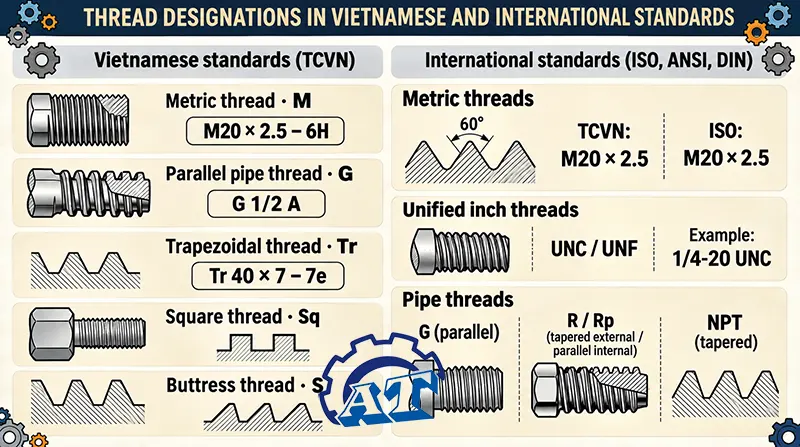
Reading a thread callout accurately keeps your shop from machining or ordering the wrong mating part. ISO callouts follow a strict left-to-right order covering profile, size, pitch, tolerance, and direction.
Standard ISO Metric Thread Reference Table
| Size | Coarse Pitch (mm) | Common Fine Pitch (mm) | Coarse Tap Drill (mm) |
| M6 | 1.0 | 0.75 | 5.0 |
| M8 | 1.25 | 1.0 | 6.8 |
| M10 | 1.5 | 1.25 / 1.0 | 8.5 |
| M12 | 1.75 | 1.5 / 1.25 | 10.2 |
| M16 | 2.0 | 1.5 | 14.0 |
| M20 | 2.5 | 1.5 | 17.5 |
(Tap drills target ~75% thread engagement in carbon steel; adjust for stainless steel or plastics.)
Decoding Thread Callouts on Engineering Drawings
Break down M12 x 1.25 - 6g - LH piece by piece:
-
M: ISO Metric 60° profile. -
12: 12 mm nominal major diameter. -
x 1.25: 1.25 mm fine pitch (omitted if standard 1.75 mm coarse). -
6g: Tolerance class. Lowercase (g,h) means external; uppercase (H,G) means internal. -
LH: Left-hand thread (omitted for standard right-hand).
Comparing ISO Metric, Unified (UNC/UNF), and BSP Standards
| Standard | Units | Angle | Primary Use |
| ISO Metric (M) | mm | 60° | Global manufacturing, automotive, CNC |
| Unified (UNC/UNF) | Inches (TPI) | 60° | North America, aerospace |
| BSP (BSPT/BSPP) | Nominal inch (TPI) | 55° | Europe/Asia plumbing and hydraulics |
| NPT | Nominal inch (TPI) | 60° | North American piping and pneumatics |
Common Screw Thread Failures and How to Fix Them
Most thread damage comes from over-torqueing, cross-threading, galling, or rust. Knowing when to repair versus when to scrap saves both downtime and safety risks.
Stripped Threads: Root Causes and Repair Options
Threads strip when you over-torque steel bolts into soft aluminum or start a bolt crooked. Fix damaged internal holes using three tiers:
-
Thread Chaser: Straightens lightly flattened crests without cutting away good metal.
-
Helicoil Insert: Drill, tap oversize, and wind in a stainless coil to restore the original bolt size with better wear resistance.
-
Solid Bushing (Time-Sert): Best for high-load engine blocks and structural mounts.
Chipped or Cracked Threads: When to Replace Immediately
Scrap any bolt with root cracks, a stretched shank, or more than one full turn chipped away. High-grade bolts (8.8, 10.9, 12.9) snap suddenly once a root crack starts. Replace the bolt and check the mating hole with a GO/NO-GO gauge.
Seized and Rusted Threads: Safe Removal Procedure
Carbon steel seizes from rust; stainless steel locks up from galling (cold welding). To remove a stuck bolt without snapping the head:
-
Wire-brush exposed threads, soak with penetrating oil, and wait 15–30 minutes.
-
Rock the wrench back and forth gently to break the rust bond.
-
Warm the nut or housing (not the bolt) to expand the internal thread.
-
Coat stainless threads with anti-seize during reassembly.
Frequently Asked Questions About Screw Threads
What is the difference between a threaded joint and a welded joint?
A threaded joint uses bolts or studs to create a removable connection for easy maintenance. A welded joint fuses metal permanently - lighter and leak-proof, but you have to cut or grind it apart to disassemble.
Where are left-hand screw threads actually used?
Left-hand threads tighten counterclockwise where rotation would spin a normal bolt loose. Common examples include left bicycle pedals, bench grinder arbors, turnbuckles, and flammable gas cylinder valves.
Can you connect an NPT pipe thread to a BSP pipe thread?
No. NPT uses a 60° angle while BSP uses a 55° angle, and their pitches rarely match. Forcing them damages both fittings and causes leaks - always use a proper NPT-to-BSP adapter.
How do I identify an unknown screw thread accurately?
Measure the outside diameter with digital calipers, then match the ridge spacing using a metric/imperial pitch gauge. Finally, check with a straightedge to see if the thread tapers (pipe) or runs straight.
Related News

27/11
2026
In the field of cargo securing, transportation, and load restraint, J hooks, U hooks, and S hooks are among the most commonly used accessories. Each type of hook features a distinct design, construction, and range of applications, making it suitable for different operational requirements.
So, what are the differences between J hooks, U hooks, and S hooks? Which type offers the highest load-bearing capacity? And when should each type of hook be used?

25/11
2026
For stainless steel laser cutting, send a 1:1 scale DXF file for machine programming along with a dimensioned PDF to prevent cutting errors. Review the DXF, DWG, and PDF comparison chart, 3 shop-ready file export rules, and 5 common CAD mistakes to avoid.

17/11
2026
In laser metal cutting, product accuracy depends not only on machine power and cutting speed but also on various other technical parameters. One of the key factors that is often discussed is Kerf Width, which refers to the width of the cut produced by the laser.
What is kerf width? Why does it affect machining quality? And how can this parameter be controlled to minimize dimensional deviations and optimize production efficiency? Let's explore these questions in the following article.

14/11
2026
Mechanical engineering manufacturing is one of the fundamental engineering disciplines driving the development of modern industry. Almost every product and piece of equipment used in manufacturing, from industrial machinery and automotive components to agricultural equipment and everyday consumer goods, relies on mechanical manufacturing technologies at some stage of its production.
View more