

25mm vs 50mm Ratchet Buckle Differences – Complete B2B Buyer’s Guide
- 1. Core Differences at a Glance - Width, Load, and Applications
- 2. Load Capacity - WLL and Breaking Strength Comparison
- Typical WLL ranges for 25mm ratchet buckles
- Typical WLL ranges for 50mm ratchet buckles
- How WLL affects safety and compliance
- 3. Application Scenarios - When to Use 25mm vs 50mm
- Ideal uses for 25mm ratchet buckles
- Ideal uses for 50mm ratchet buckles
- Common misapplications and risks
- 4. Hardware and Webbing Compatibility
- 5. Standards and Compliance - EN, WSTDA, and Labeling
- How standards treat 25mm and 50mm differently
- Labeling requirements for 25mm vs 50mm straps
- Why compliance is more critical for 50mm applications
- 6. Ergonomics, Size, and Handling Differences
- 7. Cost and Total Cost of Ownership (TCO)
- 8. OEM/ODM Considerations - Customization for Each Width
- 9. Decision Framework - How to Choose Between 25mm and 50mm
- 10. FAQs - Quick Answers for Buyers and Engineers
- 11. Key Takeaways for 25mm vs 50mm Ratchet Buckles
Choosing between 25mm and 50mm ratchet buckles isn't just about size - it defines your Working Load Limit (WLL), safety, and compliance. To prevent load failures and budget waste, this An Thanh Tech guide breaks down capacities, applications, and OEM standards for B2B buyers.
While 25mm (1-inch) and 50mm (2-inch) are the two most common ratchet buckle sizes globally, B2B buyers frequently mismatch them with their cargo needs. Misunderstanding the vast difference in load capacity, international standards, and hardware mechanics often leads to either catastrophic load failure or wasted procurement budgets.
In this comparative guide by An Thanh Tech, we break down the exact differences between 25mm and 50mm ratchet buckles. We will compare their Working Load Limits (WLL), practical applications, and OEM compliance requirements to help you choose the right hardware for your supply chain.
1. Core Differences at a Glance - Width, Load, and Applications
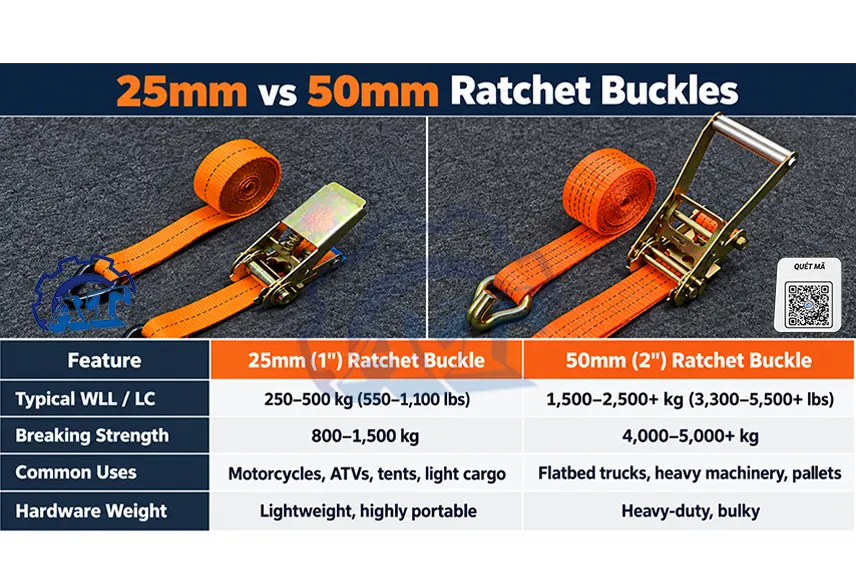
Side-by-side comparison table (25mm vs 50mm)
| Feature | 25mm (1") Ratchet Buckle | 50mm (2") Ratchet Buckle |
| Typical WLL / LC | 250 – 500 kg (550 – 1,100 lbs) | 1,500 – 2,500+ kg (3,300 – 5,500+ lbs) |
| Breaking Strength | 800 – 1,500 kg | 4,000 – 5,000+ kg |
| Common Uses | Motorcycles, ATVs, tents, light cargo | Flatbed trucks, heavy machinery, pallets |
| Hardware Weight | Lightweight, highly portable | Heavy-duty, bulky |
Why width matters more than you think
Width directly correlates to load distribution. A 50mm mandrel provides twice the surface area of a 25mm mandrel, allowing it to grip thicker webbing and distribute massive tension without cutting into the strap. You can never substitute a 50mm buckle with a 25mm one simply because they "look mechanically similar."
2. Load Capacity - WLL and Breaking Strength Comparison
Typical WLL ranges for 25mm ratchet buckles
Designed for light-duty tasks, a standard 25mm buckle usually offers a Working Load Limit (WLL) of 250 to 500 kg. Their Breaking Strength maxes out around 800 to 1,500 kg depending on the alloy used.
Typical WLL ranges for 50mm ratchet buckles
Engineered for industrial logistics, 50mm buckles boast a WLL of 1,500 to 2,500 kg, with heavy-duty variations reaching up to 5,000 kg. Their Breaking Strength safely exceeds 4,000 to 5,000 kg.
How WLL affects safety and compliance
Under EN 12195-2 and WSTDA standards, Lashing Capacity (LC) or WLL is the only metric that matters for compliance. Overloading a 25mm buckle past its 500kg limit is a direct violation of safety protocols, rendering your transport insurance void.
3. Application Scenarios - When to Use 25mm vs 50mm
Ideal uses for 25mm ratchet buckles
Best for cargo under 500 kg.
-
Securing motorcycles, ATVs, or kayaks to small trailers.
-
Tying down light warehouse boxes, sports equipment, or event tents.
-
Pros: Compact, easy to store, and highly cost-effective.
Ideal uses for 50mm ratchet buckles
Best for cargo ranging from 1,500 to 5,000 kg.
-
Securing industrial pallets, flatbed truck loads, and shipping containers.
-
Heavy machinery and automotive transport.
-
Pros: Maximum safety, legally compliant for highway transport, reduces B2B liability.
Common misapplications and risks
-
The Overload Risk: Using a 25mm strap to tie down a 1,000 kg machine guarantees hardware deformation and strap snapping.
-
The Overkill Risk: Using bulky 50mm hardware for light camping gear wastes money and makes tensioning unnecessarily difficult.
4. Hardware and Webbing Compatibility
Buckle-to-webbing width matching
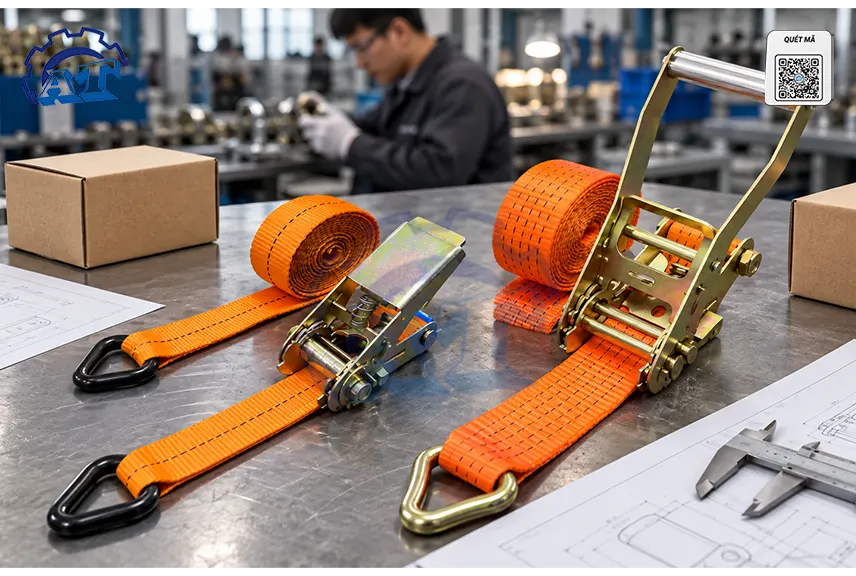
A 25mm buckle only accepts 25mm webbing; a 50mm buckle only takes 50mm webbing. Forcing mismatched sizes causes the strap to bunch up, shred against the metal flanges, or slip off the spool entirely.
Hook and end fitting considerations
-
25mm systems: Typically paired with light-duty S-hooks or wire hooks.
-
50mm systems: Require heavy-duty forged Clevis hooks, Grab hooks, or Double J-hooks to match the high WLL.
Material and finish differences
25mm hardware is often stamped from lighter steel or zinc alloys with basic plating. 50mm hardware demands heat-treated carbon steel and thick zinc-plating or stainless steel to survive harsh outdoor logistics.
5. Standards and Compliance - EN, WSTDA, and Labeling
How standards treat 25mm and 50mm differently
Both sizes can be certified. However, 50mm straps face extreme scrutiny from customs and highway patrols (under CE, GS, or WSTDA) because they secure life-threatening cargo on public roads.
Labeling requirements for 25mm vs 50mm straps
Regardless of size, compliant systems must have a blue label stating:
-
LC (Lashing Capacity).
-
STF (Standard Tension Force).
-
Manufacturer name, testing standard, and production year.
Why compliance is more critical for 50mm applications
In B2B logistics, a failed 50mm strap causes highway pile-ups or ruined multi-million-dollar equipment. Large buyers strictly require COA (Certificate of Analysis) and test reports for 50mm shipments to mitigate legal risks.
6. Ergonomics, Size, and Handling Differences
Handle design and leverage
-
25mm: Features short, narrow handles. It requires minimal physical effort but generates lower tension force.
-
50mm: Features long, wide aluminum or steel handles designed for two-handed operation or use with thick work gloves to generate massive clamping force.
Weight and bulkiness
A 25mm assembly is light enough to toss into a car trunk. A 50mm assembly is heavy, bulky, and typically stored in dedicated truck compartments.
Ease of threading and tensioning
While 25mm straps are faster to thread and tension for quick jobs, 50mm mandrels are engineered with deeper gears that hold high tension securely over long distances without slipping.
7. Cost and Total Cost of Ownership (TCO)
Unit price comparison
25mm hardware is significantly cheaper to manufacture and ship, making it ideal for low-budget, non-critical retail applications.
Lifecycle and replacement costs
While a 50mm buckle costs more upfront, its heavy-duty steel frame ensures a much longer lifecycle. Constantly replacing broken 25mm buckles used beyond their limits costs a business more in the long run than investing in proper 50mm hardware.
When it’s worth upgrading from 25mm to 50mm
Upgrade to 50mm immediately if your cargo weight exceeds 500kg, your shipment frequency increases, or you are exporting goods into the strictly regulated EU, US, or Australian markets.
8. OEM/ODM Considerations - Customization for Each Width
Custom WLL and dimensions
OEMs can tweak 25mm buckles for specific tight spaces. For 50mm buckles, customization focuses on modifying handle lengths and engineering higher WLL ratings for specialized project cargo.
Marking, packaging, and testing
Both can be laser-engraved with your logo. However, wholesale 50mm orders require strict AQL (Acceptable Quality Limit) inspections and batch-load testing before packaging.
MOQ and lead time differences
25mm hardware generally has lower MOQs and faster lead times due to simpler manufacturing. 50mm buckles require heavier tooling and longer testing phases, slightly extending production time.
9. Decision Framework - How to Choose Between 25mm and 50mm
Key questions to ask before buying
-
What is the max cargo weight? (Under 500kg or over 1,500kg?)
-
What is the transport environment? (Local pickup truck vs. cross-ocean flatbed?)
-
Are compliance certificates required? (EN, CE, WSTDA?)
Simple selection flowchart
-
Cargo < 500 kg + no strict road compliance needed ==> Choose 25mm.
-
Cargo 500–1,500 kg ==> Consider high-end 35mm (if available) or light-duty 50mm.
-
Cargo > 1,500 kg + exporting to EU/US/AUS ==> Choose 50mm exclusively.
Common buyer mistakes to avoid
Never buy based purely on unit price. Using cheap 25mm straps for "temporary" heavy loads is the leading cause of warehouse and transport accidents.
10. FAQs - Quick Answers for Buyers and Engineers
A. Can I use a 25mm ratchet buckle for a 1-ton cargo?
No. A 1-ton (1,000kg) cargo far exceeds the safe Working Load Limit (WLL) of a standard 25mm buckle, guaranteeing equipment failure.
B. Is 50mm overkill for motorcycles?
Generally, yes. Unless securing extremely heavy custom cruisers on flatbeds, a high-quality 25mm or 35mm strap is much easier to navigate around delicate bike parts.
C. Do 25mm and 50mm buckles share the same hooks?
No. Hooks are engineered specifically for the width of the webbing and the WLL of the system. A 25mm S-hook will snap under 50mm tension loads.
D. Which width is required for EN 12195-2 compliance?
Both sizes can be manufactured to meet EN 12195-2 standards, but 50mm is the industry standard demanded by transport authorities for commercial freight.
11. Key Takeaways for 25mm vs 50mm Ratchet Buckles
The difference between 1-inch and 2-inch tie-downs goes far beyond physical size. It dictates your Working Load Limit (WLL), the types of cargo you can legally transport, and your compliance with international safety laws. Match 25mm hardware to light recreational loads, and reserve heavy-duty 50mm hardware for serious commercial logistics.
Need help scaling your cargo control inventory? Contact An Thanh Tech today to receive detailed comparison datasheets, request physical 25mm and 50mm OEM samples, and secure wholesale B2B pricing for your next project.
Related News

15/10
2026
Match a ratchet buckle, webbing, and hooks across four criteria: webbing width, complete-assembly load rating (WLL/LC), operating environment, and anchor-point geometry. Pair the buckle to the webbing’s exact width and thickness, rate the assembly by its weakest link, and ensure hooks seat fully without tip loading.

15/10
2026
Understanding ratchet buckle load ratings is essential for safe cargo securement. This guide explains the difference between WLL (Working Load Limit), LC (Lashing Capacity) and breaking strength, shows how to read a ratchet strap label, and helps buyers select the correct ratchet buckle assembly for US, EU and Australian transport applications.

24/09
2026
Got a jammed or rusted buckle but perfectly good webbing? Don't toss the whole assembly. Learning how to replace a ratchet buckle on a tie down strap saves money and ensures safety compliance. Follow our step-by-step 2026 guide to safely swap your damaged buckle in minutes.

24/09
2026
Heavy-duty 50mm (2-inch) webbing is only as safe as its ratchet buckle. The wrong hardware inevitably leads to strap abrasion or load failure. Learn how to select the correct 50mm buckle based on WLL, EN/WSTDA standards, and B2B OEM requirements.
View more