

How to Match a Ratchet Buckle with Webbing and Hooks
- Why Matching Ratchet Buckle, Webbing, and Hooks Matters
- Understand the Three Core Components
- Match by Ratchet Buckle Webbing Width First
- Match by Load Rating, Not Break Strength (WLL & LC vs. BF)
- 1. Flat Hook
- 2. Wire Hook / Double-J Hook
- 3. S-Hook
- 4. Latching / Safety Hook
- 5. E-Track Fitting / Spring E-Fitting
Match a ratchet buckle, webbing, and hooks across four criteria: webbing width, complete-assembly load rating (WLL/LC), operating environment, and anchor-point geometry. Pair the buckle to the webbing’s exact width and thickness, rate the assembly by its weakest link, and ensure hooks seat fully without tip loading.
Achieving reliable ratchet strap compatibility requires selecting your ratchet buckle, cargo webbing, and end-fitting hooks as one engineered web lashing assembly. For B2B importers, distributors, and OEM strap assemblers, aligning component width, working load limits, anchor geometry, and EN 12195-2 or FMCSA standards ensures safe cargo securement and prevents premature hardware failure.
Why Matching Ratchet Buckle, Webbing, and Hooks Matters
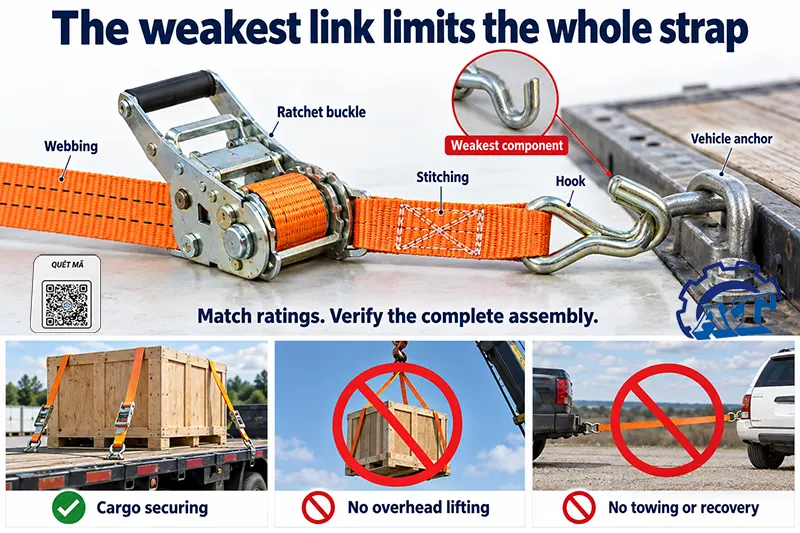
A ratchet strap functions as a single safety chain: webbing + ratchet buckle + stitch pattern + hook + vehicle anchor point.
-
The Weakest-Link Rule: Complete assembly capacity equals its lowest-rated component. Pairing "5-ton / 10,000 lb" webbing with an under-rated ratchet buckle, weak sewing thread, or a light-duty hook reduces the entire strap’s safe load to that weakest part.
-
Strict Application Limit: Ratchet straps are designed strictly for cargo securing and tie-down. Never use them for overhead lifting, hoisting, or dynamic vehicle recovery/towing.
Understand the Three Core Components
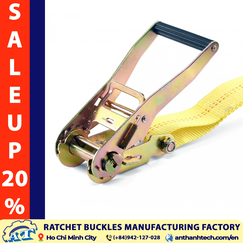
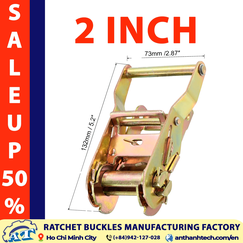
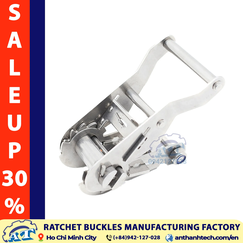
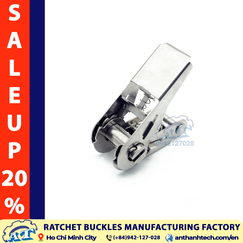
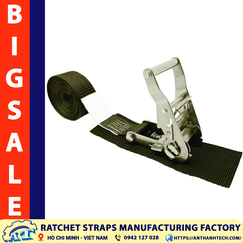
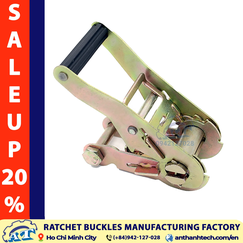
1. Ratchet Buckle
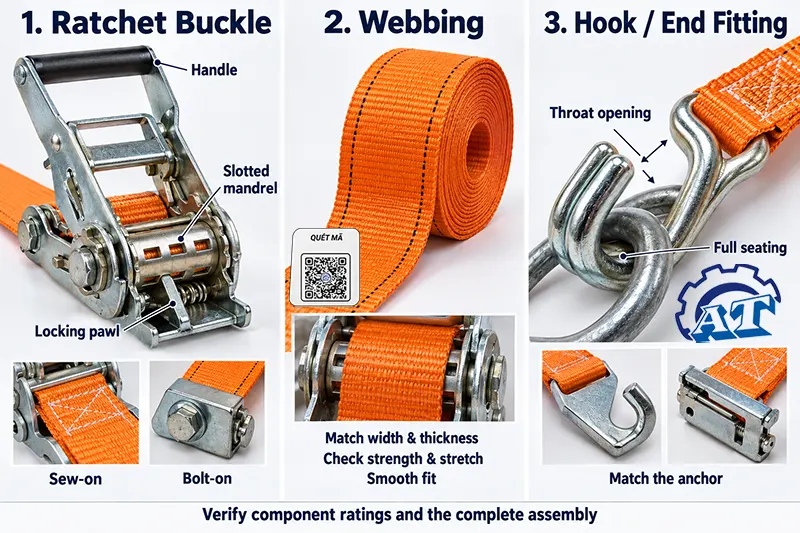
The ratchet buckle feeds webbing through a slotted mandrel, tensions the line via lever action, and locks load tension with a spring-loaded pawl.
-
For Maximum Webbing Width: 25 mm (1"), 35 mm (1.5"), 50 mm (2"), 75 mm (3"), and 100 mm (4").
-
Handle Styles: Paddle/thumb release (light duty), standard grab handle, extended/ergonomic grab handle, and rubber-coated handle.
-
Mounting Types: Sew-on (permanently stitched) or No-sew (quick-release clevis bolt).
-
Materials & Finishes: Zinc-plated steel, powder-coated steel, or 304/316 stainless steel for wet, marine, and corrosive environments.
-
Technical Note on STF vs. LC: Long/ergonomic handles generate higher Standard Tension Force (STF) for friction lashing, but STF never increases the strap's Lashing Capacity (LC).
2. Webbing
Industrial webbing carries the tensile load and controls stretch during transit.
-
Polyester (PES): Industry standard for outdoor EN 12195-2 ratchet straps; offers low elongation (< 7% at LC), high UV stability, low moisture absorption, and good acid resistance.
-
Nylon (Polyamide): Soft, flexible, and shock-absorbing, but stretches more (8–15%) and loses ~10–15% strength when wet.
-
Polypropylene (PP): Lightweight and economical for light indoor bundling, but lower in load capacity, heat tolerance, and UV resistance.
-
Matching Rule: Match nominal width, thickness, weave, break strength, and elongation at LC to the buckle. Webbing must fit smoothly inside the ratchet's maximum width and mandrel slot (1.5 to 3 wraps required without frame jamming).
3. Hook / End Fitting
Hooks connect the strap to the trailer or cargo anchor point (rub rail, D-rings, lashing ring, stake pocket, E-track, shackle, or eye bolt).
-
Geometry Checks: Verify throat opening width, wire diameter/thickness, keeper/latch clearance, pull angle, and full seating inside the hook saddle (never tip-load a hook).
-
Load Balance: Both the hook and the vehicle anchor point must meet or exceed the required complete-assembly load rating.
Match by Ratchet Buckle Webbing Width First
Suppliers classify ratchets by "For Maximum Webbing Width." Always match nominal width first:
| Webbing Width | Matching Ratchet Buckle | Typical Applications |
| 25 mm / 1" | Ratchet 25 mm / 1" | Light tie-downs, furniture, small vans, powersports |
| 35 mm / 1.5" | Ratchet 35 mm / 1.5" | Medium freight, pallets, light commercial equipment |
| 50 mm / 2" | Ratchet 50 mm / 2" | Standard cargo securing, flatbeds, sea containers |
| 75 mm / 3" | Ratchet 75 mm / 3" | Heavy industrial machinery, steel coils, plant cargo |
| 100 mm / 4" | Ratchet 100 mm / 4" | Heavy-duty flatbed winches & oversized loads |
-
Manufacturing Tolerance Tip: Nominal webbing width and thickness vary slightly across mills. Always confirm fitment using technical drawings and physical samples before bulk OEM production.
Match by Load Rating, Not Break Strength (WLL & LC vs. BF)
Never use raw webbing break strength as your safe working load:
-
WLL (Working Load Limit): Maximum safe working load in North America (WSTDA / FMCSA), typically 1/3 of assembly break strength.
-
LC (Lashing Capacity): Maximum safe working tension under European standard EN 12195-2, measured in daN (1daN ~ 1kgf).
-
BF / Break Strength (Breaking Force): Minimum destructive failure load - never the allowable working load.
Regional Compliance Rules:
-
EU Standard (EN 12195-2): Requires testing and labeling the complete assembly (webbing + ratchet + end fitting). Minimum assembly BF must be at least 2 LC (raw webbing 3LC).
-
US Standard (FMCSA): Securement calculations must use assembly WLL. Total aggregate WLL of all tie-downs must equal at least 50% of total cargo weight, alongside minimum strap count rules.
-
Example: A 50 mm webbing with 7,500 daN break strength stitched to a lower-rated ratchet or hook drops its legal assembly rating to the weakest hardware limit.
Read our related article: Ratchet Buckle Load Ratings Explained: WLL, LC and Breaking Strength.
Match Ratchet Strap Hook Types to the Anchor Point
1. Flat Hook
-
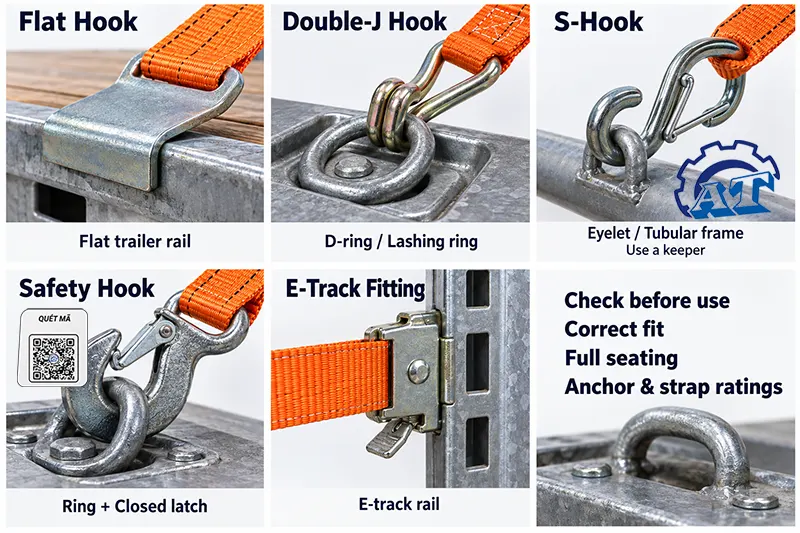
Best For: Flatbed trailer rub rails and flat steel side edges.
-
Advantage: Wide contact area for stable, flat seating.
-
Check: Rail edge thickness, hook seat width, and slip-free flat alignment.
Buy this product here: Flat Hooks manufacturing
2. Wire Hook / Double-J Hook
-
Best For: D-rings, forged lashing rings, perforated rails, and narrow lugs.
-
Advantage: Versatile profile; closed/double-J shape reduces unhooking risk on round rings.
-
Check: Wire diameter, throat opening width, pull angle, and D-ring load rating.
Contact us for custom J-hook manufacturing
3. S-Hook
-
Best For: Light-to-medium rings, eyelets, and tubular frames.
-
Check: Open S-hooks can detach if cargo shifts or lines slacken; choose S-hooks with a spring keeper/safety latch for road transport.
4. Latching / Safety Hook
-
Best For: High-vibration transport, car haulers, and shifting or suspension-mounted loads.
-
Advantage: Integrated spring keeper locks the hook onto the ring even if the strap loses tension.
5. E-Track Fitting / Spring E-Fitting
-
Best For: Horizontal or vertical E-track rails in enclosed box trucks, dry vans, and trailers.
-
Check: Track slot geometry, mounting orientation, positive spring-pin engagement, and the installed track-to-strap load rating.
Match Material and Environment
-
Outdoor, Coastal & Road Salt: Specify 304/316 stainless steel or heavy corrosion-resistant plated hardware; ensure webbing, thread, and anchors match the environment.
-
High UV Exposure: Use UV-stabilized polyester webbing; inspect regularly for stiffness, fading, and edge fraying.
-
Chemical Exposure: Verify chemical type, concentration, and temperature (polyester resists most weak acids; nylon resists alkalis).
-
Temperature Extremes: Confirm thermal limits for webbing, sewing thread, labels, and metal coatings (standard polyester assemblies operate from -40°C to +100°C).
Compatibility Checklist for B2B Buyers
-
Confirm Target Standard: Specify EN 12195-2 (LC/STF/BF) for EU or WSTDA/FMCSA (WLL) for North America.
-
Define Cargo & Lashing Method: Identify cargo weight/shape and choose friction/top-over lashing (high STF) vs. direct lashing (high LC/WLL).
-
Match Width First: Select webbing width, then pair a ratchet with the exact "Maximum Webbing Width" and mandrel slot capacity.
-
Require Complete-Assembly Ratings: Demand certified load ratings for webbing + ratchet + hook + stitching combined.
-
Select Hooks by Anchor Geometry: Match hooks to actual trailer anchor points, not price or standalone break numbers.
-
Verify Strap Lengths: Confirm overall length and fixed-end length (0.3 - 0.5 m) to keep the ratchet handle clear of cargo edges.
-
Inspect Compliance Labels: Verify LC/WLL, STF, SHF, BF (if applicable), material, manufacturing year, traceability code, manufacturer name, and "Not for Lifting".
-
Request Samples & Test Reports: Require golden samples, Type Test records, and batch tensile test reports for OEM/ODM orders.
Common Matching Mistakes to Avoid
-
Forcing 50 mm webbing into a 35 mm ratchet, or jamming thick webbing into a narrow mandrel slot.
-
Choosing hooks by webbing strength while ignoring anchor-point geometry (causing tip loading).
-
Mistaking Break Strength (BF) for safe working capacity (WLL/LC).
-
Mixing ratchets, webbing, and hooks from different vendors without testing the stitched complete assembly.
-
Using ratchet straps for overhead lifting or dynamic vehicle recovery.
-
Omitting corner protectors over sharp edges (EN 12195-2 requires abrasion and cut protection).
-
Failing to re-check and re-tension straps shortly after departure and periodically during transit.
Example: Building a 2-Inch (50 mm) Ratchet Strap
Scenario: Securing heavy palletized machinery on a flatbed trailer using a 2" (50 mm) ratchet strap. Copy this table directly into supplier RFQs:
| Component | Specification | Why It Matters |
| Webbing | 50 mm (2") 100% Polyester, low elongation (< 7% at LC), UV treated, raw BF 7,500 daN. | Prevents transit stretch, resists UV/moisture, and provides a 3:1 raw textile safety factor. |
| Ratchet Buckle | 50 mm (2") Long-Handle Ratchet, zinc-plated or 304 SS, STF 350 -- 500 daN, BF 5,000 daN. | Fits 50 mm webbing smoothly; long lever increases downward friction tension (STF). |
| Hook / End Fitting | 50 mm Double-J Hook (for D-rings) or Flat Hook (for rub rails), forged steel, BF 5,000 daN. | Seats fully on the trailer’s specific anchor point without bending or unhooking. |
| Stitching & Assembly | Contrasting PES thread, automated Bartack/Box-X pattern; Assembly LC 2,500 daN / WLL 3,333 lbs. | Ensures sewn terminations match hardware strength and pass DOT / EN 12195-2 inspections. |
| Corner Protector | Heavy-duty PVC sleeves or HDPE corner vee-boards at all contact edges. | Protects tensioned webbing from cutting or abrasion on sharp machinery edges. |
Frequently Asked Questions
Can I use any 2-inch webbing with any 2-inch ratchet buckle?
No. You must match actual webbing width tolerance, thickness, mandrel slot capacity, mounting style, and complete-assembly load rating.
Should the hook be stronger than the webbing?
The hook must have a load rating equal to or greater than the target assembly rating, though raw webbing break strength is typically higher (3 LC) to account for stitching and wear. The overall strap is always limited by its weakest component.
What is the difference between WLL and LC?
WLL (Working Load Limit) is the North American safe working load rating (in lbs or kg per WSTDA/FMCSA). LC (Lashing Capacity) is the European safe working load rating under EN 12195-2, measured in daN.
Can I mix components from different suppliers?
Only if you conduct destructive tensile testing on the final stitched assembly to certify the complete assembly rating. Never infer assembly capacity from individual part specs.
Are ratchet straps suitable for lifting?
No. Ratchet straps are strictly for cargo securing and tie-down, never for overhead lifting or hoisting.
Related News

15/10
2026
Understanding ratchet buckle load ratings is essential for safe cargo securement. This guide explains the difference between WLL (Working Load Limit), LC (Lashing Capacity) and breaking strength, shows how to read a ratchet strap label, and helps buyers select the correct ratchet buckle assembly for US, EU and Australian transport applications.

24/09
2026
Got a jammed or rusted buckle but perfectly good webbing? Don't toss the whole assembly. Learning how to replace a ratchet buckle on a tie down strap saves money and ensures safety compliance. Follow our step-by-step 2026 guide to safely swap your damaged buckle in minutes.

24/09
2026
Choosing between 25mm and 50mm ratchet buckles isn't just about size - it defines your Working Load Limit (WLL), safety, and compliance. To prevent load failures and budget waste, this An Thanh Tech guide breaks down capacities, applications, and OEM standards for B2B buyers.

24/09
2026
Heavy-duty 50mm (2-inch) webbing is only as safe as its ratchet buckle. The wrong hardware inevitably leads to strap abrasion or load failure. Learn how to select the correct 50mm buckle based on WLL, EN/WSTDA standards, and B2B OEM requirements.
View more