

Ratchet Buckle Load Ratings Explained: WLL, LC and Breaking Strength
- What Do Ratchet Buckle Load Ratings Mean?
- WLL Ratchet Strap Meaning & Calculation
- What Does WLL Mean on a Ratchet Strap?
- How Many Ratchet Straps Do I Need? (FMCSA WLL Formula)
- WLL vs SWL: Which Term Should You Use?
- Lashing Capacity LC Explained (EN 12195-2)
- What Is Lashing Capacity LC on a Ratchet Strap?
- WLL vs LC: Key Differences
- How to Convert LC (daN) to kg
- Breaking Strength Ratchet Strap Ratings Explained
- What Is Breaking Strength (MBS / BF)?
- Is Breaking Strength the Same as WLL?
- Comparison: WLL vs LC vs Breaking Strength vs STF
- How to Read an EN 12195-2 Ratchet Strap vs US Label
- How to Choose the Right Ratchet Strap Load Rating
- 1. Match the Rating to Your Target Market & Lashing Method
- 2. Typical Ratchet Strap Load Ratings by Webbing Width
- 3. Real-World Factors That Reduce Effective Capacity
- Real-World Calculation Examples
- 7 Common Mistakes With Ratchet Buckle Load Ratings
- B2B Buyer Checklist: How to Verify Supplier Quality
- Frequently Asked Questions (FAQ)
Understanding ratchet buckle load ratings is essential for safe cargo securement. This guide explains the difference between WLL (Working Load Limit), LC (Lashing Capacity) and breaking strength, shows how to read a ratchet strap label, and helps buyers select the correct ratchet buckle assembly for US, EU and Australian transport applications.
Understanding ratchet buckle load ratings is essential for safe, compliant cargo securement across international supply chains. Whether you are sourcing hardware or securing heavy freight, misreading a ratchet strap load rating can lead to failed roadside inspections or catastrophic load shifts. This technical guide explains WLL vs LC, breaking strength, STF, and how to select the right assembly for US, EU, and Australian transport standards
What Do Ratchet Buckle Load Ratings Mean?
Ratchet buckle load ratings define the maximum tension force a complete tie-down assembly is certified to handle during cargo restraint. In North America, this working limit is expressed as WLL (Working Load Limit). In Europe and Australia, it is expressed as LC (Lashing Capacity). Breaking strength represents the destructive failure threshold and must never be used as a working load.
In industrial rigging, a ratchet strap load rating never measures the raw polyester webbing or metal buckle alone. It evaluates the complete assembly - combining the webbing, ratchet buckle frame, load-bearing stitch patterns, and end hooks.
Expert Warning: Many retail packages print the highest number (e.g., "10,000 lbs" or "5,000 kg") in large text. That figure is almost always the breaking strength, not the actual working capacity (WLL or LC).
WLL Ratchet Strap Meaning & Calculation
What Does WLL Mean on a Ratchet Strap?
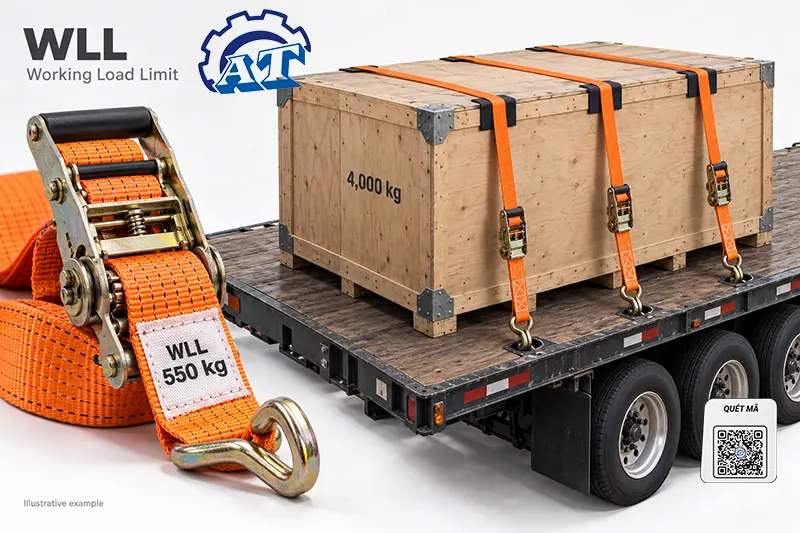
If you are asking what does WLL mean on a ratchet strap, WLL stands for Working Load Limit - the maximum load force a complete tie-down assembly can safely sustain during normal highway transport.
Under North American WSTDA T-1 and FMCSA 49 CFR Part 393 standards, a WLL ratchet strap rating is calculated using a 3:1 safety factor (WLL = 1/3 of Minimum Breaking Strength).
How Many Ratchet Straps Do I Need? (FMCSA WLL Formula)
A common operational question is: how many ratchet straps do I need to legally secure a load? Under US FMCSA regulations, the aggregate WLL of all tie-downs must equal at least 50% of the total cargo weight, alongside minimum strap-count rules based on cargo length:
Required Aggregate WLL >= 0.50 X Total Cargo Weight
-
Length Rule: At least 1 strap for cargo <= 5 <=1,100lbs 2 straps for cargo <= 5 ft and > 1,100 lbs, or between 5 ft and 10 ft; plus 1 additional strap for every 10ft of cargo length beyond the first 10ft (if unblocked).
-
Calculation Example: To secure a 4,000 kg (8,818lbs) machine, your minimum required WLL is 2,000 kg (4,409lbs). Using four straps rated at WLL 550kg each yields an aggregate WLL of 2,200kg - compliant and safe.
-
Anchor Routing Note: A strap passing from one vehicle anchor point, over the cargo, to an opposite anchor point counts for 100% of its WLL. A strap connected from a vehicle anchor directly to the cargo may only credit 50% of its WLL depending on hardware configuration.
WLL vs SWL: Which Term Should You Use?
Always specify WLL (Working Load Limit) on technical sheets and labels. SWL (Safe Working Load) is an obsolete term retired by US and international standards organizations due to legal liability - always rely on the certified WLL printed on the assembly tag.
Lashing Capacity LC Explained (EN 12195-2)
What Is Lashing Capacity LC on a Ratchet Strap?
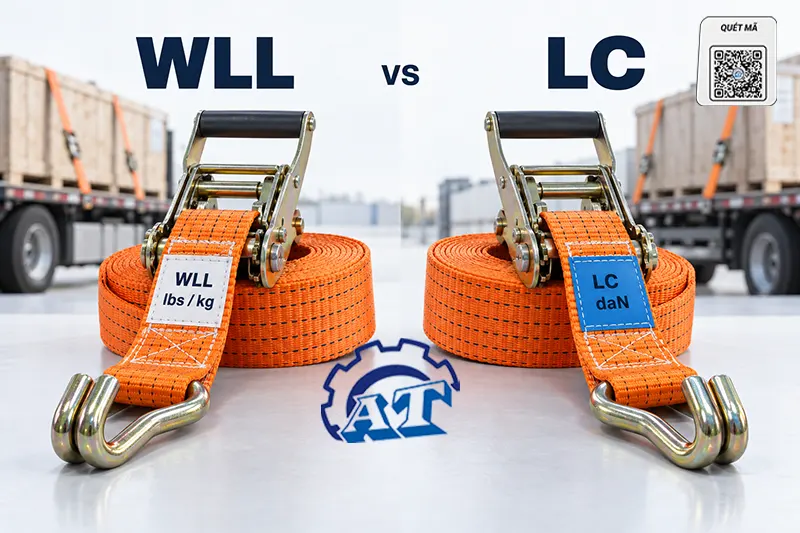
Lashing capacity LC is the maximum allowable straight-pull force a web lashing assembly is certified to sustain in direct lashing applications under European standard EN 12195-2. Measured in decanewtons (daN), lashing capacity LC uses a 2:1 safety ratio against the complete assembly's minimum breaking force (BF >= 2 X LC, while raw webbing meets 3LC). For example, an EN 12195-2 ratchet strap rated at LC 2,500 daN has a minimum assembly breaking force of 5,000 daN.
WLL vs LC: Key Differences
Understanding WLL vs LC prevents dangerous cross-market compliance errors:
| Comparison Criteria | WLL (Working Load Limit) | LC (Lashing Capacity) |
| Primary Meaning | Maximum rated working load limit | Maximum rated straight-line lashing force |
| Target Markets | USA, Canada, North America | EU, UK (EN 12195-2) & Australia/NZ (AS/NZS 4380) |
| Governing Standards | FMCSA 49 CFR Part 393, WSTDA T-1 | EN 12195-2, EN 12195-1, AS/NZS 4380 |
| Measurement Unit | Pounds (lbs) and Kilograms (kg) |
Decanewtons (daN) |
| Assembly Safety Factor | 3:1 MBS = 3 WLL) | 2:1 (BF = 2LC) |
| Primary Lashing Mode | Tie-down & direct cargo securement | Direct lashing (paired with STF for tie-downs) |
| Approved for Lifting? | No | No |
Compliance Rule: Never mathematically convert LC into WLL to bypass regional labeling laws. Each standard relies on distinct testing protocols and safety factors.
How to Convert LC (daN) to kg
In practical logistics math, 1 daN = 10 Newtons ~ 1.02kgf (kilogram-force). Field engineers use a 1:1 rule of thumb (1daN ~ 1kg):
-
LC 2,500 daN ~ 2,500kgf of straight-line holding capacity.
-
Warning: Never use this conversion to calculate overhead lifting or substitute for official US/EU certification labels.
Breaking Strength Ratchet Strap Ratings Explained
What Is Breaking Strength (MBS / BF)?
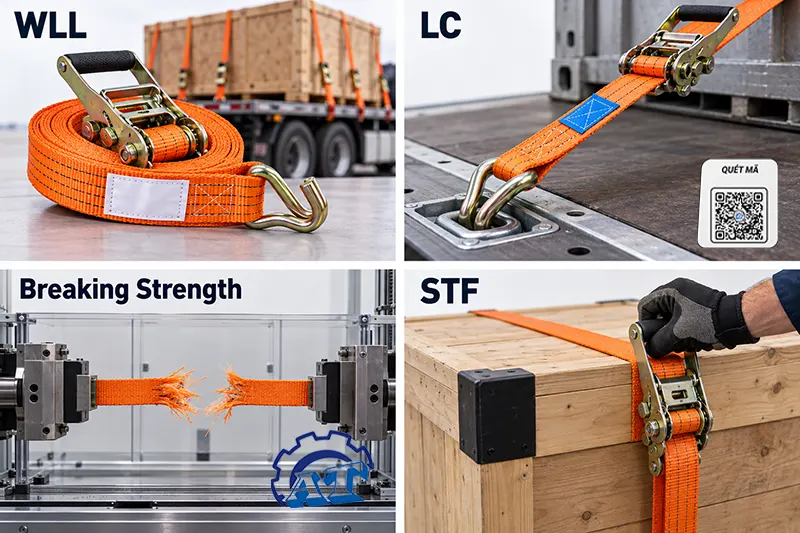
A breaking strength ratchet strap rating - also known as Minimum Breaking Strength (MBS) or Breaking Force (BF) - is the exact mechanical load at which the complete assembly snaps during destructive laboratory tension testing.
Because stitching, hooks, or the ratchet buckle axle fail before the polyester fibers, the complete assembly breaking strength is always lower than the raw webbing breaking strength.
Is Breaking Strength the Same as WLL?
No. If you are wondering is breaking strength the same as WLL, breaking strength is the failure point in a lab test, whereas WLL is the safe working load allowed on the road. Under North American standards, a 10,000 lbs breaking strength ratchet strap has a WLL of only 3,333 lbs (a 3:1 ratio). Using breaking strength to calculate cargo restraint eliminates your dynamic shock-load buffer and violates transport law.
Comparison: WLL vs LC vs Breaking Strength vs STF
| Load Rating Metric | Core Technical Question Answered | Used for Safe Securement Math? |
| WLL | What is the safe working load in North America? | Yes - US / Canada |
| LC | What is the maximum straight-pull force under EN standards? | Yes - EU / UK / AU (Direct Lashing) |
| Breaking Strength (MBS/BF) | At what force will the strap assembly snap in testing? | No - Destructive lab test value only |
| STF (Standard Tension Force) | How much downward clamping tension stays locked after ratcheting? | Yes - Essential for frictional / over-the-top tie-downs |
How to Read an EN 12195-2 Ratchet Strap vs US Label
Every compliant industrial strap requires a durable identification tag sewn into both the fixed and adjustable ends.
EN 12195-2 Label vs US WSTDA T-1 Label
| Label Field | EN 12195-2 Ratchet Strap Label (EU/UK) | US / WSTDA T-1 Label (North America) |
| Working Rating | LC in daN (e.g., LC 2,500 daN) | WLL in lbs and kg (e.g., WLL 3,333 lbs / 1,512 kg) |
| Clamping Force | Mandatory STF (e.g., STF 350 daN) | Not required in the same standardized format |
| Hand Force | Standardized SHF 50 daN | Not required on tag |
| Label Color Code | Blue = Polyester (PES), Green = Polyamide, Brown = Polypropylene | No mandatory material color coding |
| Traceability | Manufacturer ID, batch traceability code, year, EN 12195-2 | Manufacturer name/logo, WSTDA T-1 reference |
| Safety Warning | Explicit "Not for lifting!" | Explicit ratchet buckle not for lifting warning |
Important: Any ratchet strap with a missing, torn, or illegible label has an official load rating of ZERO during DOT or European roadside inspections.
How to Choose the Right Ratchet Strap Load Rating
1. Match the Rating to Your Target Market & Lashing Method
-
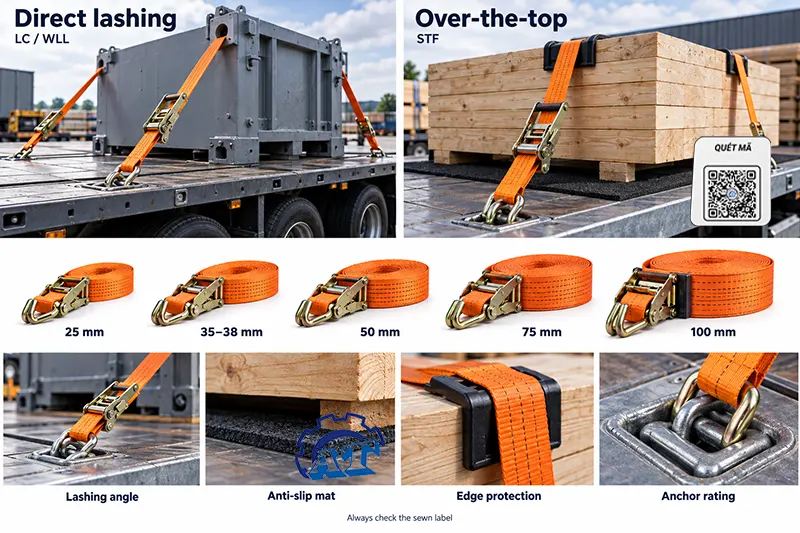
Direct Lashing (Straight Pull): Straps hook directly between vehicle anchor points and cargo lashing rings. Prioritize LC (EU/AU) or WLL (US).
-
Over-the-Top / Frictional Lashing: Straps pass over the top of pallets or timber, pressing the load onto the deck. Prioritize STF (Standard Tension Force) - a long-handle ergonomic ratchet buckle with STF 500 daN generates 66% more clamping friction than a standard buckle with STF 300 daN, even if both have an identical LC 2,500 daN.
2. Typical Ratchet Strap Load Ratings by Webbing Width
(Note: Benchmarks below reflect standard industrial configurations. Always verify the exact sewn label).
| Webbing Width | Typical WLL (US) | Typical LC (EN 12195-2) | Assembly Breaking Strength | Primary Industrial Use Cases |
| 25 mm (1") | ~500 – 833 lbs | 400 – 800 daN | 1,500 – 2,500 lbs (800 – 1,600 daN) | Motorcycles, light parcels, van interiors |
| 35–38 mm (1.5") | ~1,000 – 1,666 lbs | 1,000 – 1,500 daN | 3,000 – 5,000 lbs (2,000 – 3,000 daN) | Light machinery, ATVs, palletized boxes |
| 50 mm (2") | 3,333 lbs | 2,000 – 2,500 daN | 10,000 lbs (4,000 – 5,000 daN) | Flatbed freight, vehicles, pallets, containers |
| 75 mm (3") | ~5,400 lbs | 3,500 – 5,000 daN | 16,200 lbs (7,000 – 10,000 daN) | Heavy construction equipment, steel coils |
| 100 mm (4") | ~5,400 – 6,670 lbs | Up to 10,000 daN | 20,000 lbs (Up to 20,000 daN) | Heavy haulage, industrial transformers, mining |
3. Real-World Factors That Reduce Effective Capacity
-
Shallow Lashing Angles: In frictional tie-downs, angles below 60 (and especially below 30) drastically reduce downward clamping pressure (alpha effect).
-
Low Surface Friction: Oily steel beds require anti-slip mats to achieve calculated restraint efficiency.
-
Unprotected Sharp Edges: Steel plates, concrete blocks, and rough pallets slice tensioned webbing instantly - always install polymer corner protectors or PVC wear sleeves.
-
Under-rated Anchor Points: Attaching a LC 2,500 daN strap to a 1,000 daN chassis hook restricts the entire restraint line to 1,000 daN.
Real-World Calculation Examples
-
Example 1 – US Flatbed Securement (FMCSA): A 10,000 lbs load requires at least 5,000 lbs aggregate WLL (50%). Two 2-inch straps rated at WLL 3,333 lbs provide 6,666 lbs total WLL - meeting the weight rule (verify cargo length to confirm if a 3rd strap is needed).
-
Example 2 – EU Direct Lashing (EN 12195-2): Securing heavy plant equipment using four EN 12195-2 ratchet strap assemblies rated at LC 2,500 daN (Breaking Force 5,000daN). The 2,500 daN LC value is plugged directly into EN 12195-1 equations alongside lashing angles and chassis friction.
-
Example 3 – Frictional Tie-Down (STF Optimization): Securing palletized bricks over-the-top. Switching from standard ratchets (STF 300 daN) to long-handle pull-down ratchets (STF 500 daN) increases downward clamping force per strap by 66%, reducing the total number of required straps across the trailer.
7 Common Mistakes With Ratchet Buckle Load Ratings
-
Using Breaking Strength as Working Load: Treating a "5-Ton" (5,000 daN breaking force) strap as having a 5,000 kg working limit instead of its rated LC 2,500 daN.
-
Interchanging WLL and LC on Product Pages: Confusing US and EU terminology creates compliance failures for B2B importers.
-
Violating the "Ratchet Buckle Not for Lifting" Rule: Using cargo tie-downs as crane slings or vehicle recovery straps.
-
Buying by Webbing Width Alone: Assuming all 50 mm straps have the same rating (light-duty 50 mm straps may only rate at LC 1,000 daN).
-
Using Unlabeled or Faded Straps: Unreadable tags legally void the strap's load rating.
-
Ignoring STF in Over-the-Top Lashing: Focusing only on LC when friction and clamping tension (STF) actually hold the load in place.
-
Skipping Corner Protectors: Tensioning polyester webbing over raw metal or timber edges.
B2B Buyer Checklist: How to Verify Supplier Quality
Before placing bulk OEM or wholesale orders for ratchet buckles and strap assemblies, verify:
-
Complete Assembly Test Reports: Demand destructive pull-test certificates for the assembled strap (webbing + stitching + ratchet buckle + hook), not raw component tests.
-
Market-Specific Compliance Docs: Request Declaration of Conformity for EN 12195-2 (EU/UK), WSTDA T-1 test records (US), or AS/NZS 4380 compliance (Australia).
-
Pre-Production Label Proofs: Audit the exact label layout for correct WLL/LC units, STF/SHF ratings, batch traceability codes, and the mandatory ratchet buckle not for lifting warning.
-
Hardware Metallurgy & Coating: Confirm heat-treated carbon steel or 304/316 stainless steel frames, smooth gear teeth engagement, and salt-spray tested corrosion resistance.
Frequently Asked Questions (FAQ)
What does WLL mean on a ratchet strap?
WLL stands for Working Load Limit: the maximum force a complete ratchet strap assembly is rated to handle during normal cargo securement in North America. It is typically set at one-third (1/3) of the assembly's minimum breaking strength.
Is WLL the same as LC?
No. WLL vs LC reflects two different regional standards: WLL is the North American working rating (3:1 safety factor under WSTDA T-1/FMCSA), whereas lashing capacity LC is the European direct lashing rating (2:1 assembly safety factor under EN 12195-2). Never convert them directly.
Is breaking strength the same as WLL?
No. Breaking strength is the destructive laboratory force at which the strap assembly fails. WLL is the safe working load limit and is always three times lower than the breaking strength on North American straps.
Why is a ratchet buckle not for lifting?
A ratchet buckle not for lifting rule exists because ratchet mechanisms and tie-down stitching are engineered for static tension and road restraint, not suspended overhead loads. Overhead lifting requires certified lifting slings built to a 5:1 or 7:1 safety factor (EN 1492-1 / ASME B30.9).
How many ratchet straps do I need for my cargo?
Under US FMCSA rules, the combined WLL of all straps must equal at least 50% of the total cargo weight, with a minimum of 2 straps for most loads over 1,100 lbs or longer than 5 feet. Under EU EN 12195-1 rules, strap count depends on cargo mass, friction factor, lashing angle, and STF or LC values.
What is STF on an EN 12195-2 ratchet strap?
STF stands for Standard Tension Force: the residual clamping force (in daN) maintained in the strap after tightening the ratchet handle with a standard 50 daN hand force. STF is the primary metric used to calculate frictional over-the-top tie-downs.
Related News

15/10
2026
Match a ratchet buckle, webbing, and hooks across four criteria: webbing width, complete-assembly load rating (WLL/LC), operating environment, and anchor-point geometry. Pair the buckle to the webbing’s exact width and thickness, rate the assembly by its weakest link, and ensure hooks seat fully without tip loading.

24/09
2026
Got a jammed or rusted buckle but perfectly good webbing? Don't toss the whole assembly. Learning how to replace a ratchet buckle on a tie down strap saves money and ensures safety compliance. Follow our step-by-step 2026 guide to safely swap your damaged buckle in minutes.

24/09
2026
Choosing between 25mm and 50mm ratchet buckles isn't just about size - it defines your Working Load Limit (WLL), safety, and compliance. To prevent load failures and budget waste, this An Thanh Tech guide breaks down capacities, applications, and OEM standards for B2B buyers.

24/09
2026
Heavy-duty 50mm (2-inch) webbing is only as safe as its ratchet buckle. The wrong hardware inevitably leads to strap abrasion or load failure. Learn how to select the correct 50mm buckle based on WLL, EN/WSTDA standards, and B2B OEM requirements.
View more