

Why Cargo Straps Twist When Tightening & How to Fix It
Ever cranked down a cargo strap only to find it twisted, jammed, and losing tension on the highway?. A single twist in your lashing webbing isn't just annoying - it slashes your cargo's security by up to 25%. Here is why cargo straps twist when tightening, the hidden dangers of edge-load stress, and the proper 5-step technique to secure your freight flat, safe, and secure every single time.
Ratchet straps, also known as cargo lashing straps, can twist during tightening due to uneven threading through the ratchet mandrel, cranking the handle before removing slack by hand, or misaligned anchor hooks. Twisted webbing can distribute tension unevenly, increasing the risk of edge damage, ratchet spool jamming, or load shifting during transit. Before tightening, check that the polyester webbing lies flat, the hooks are correctly aligned, and the straps have no worn or damaged edges.
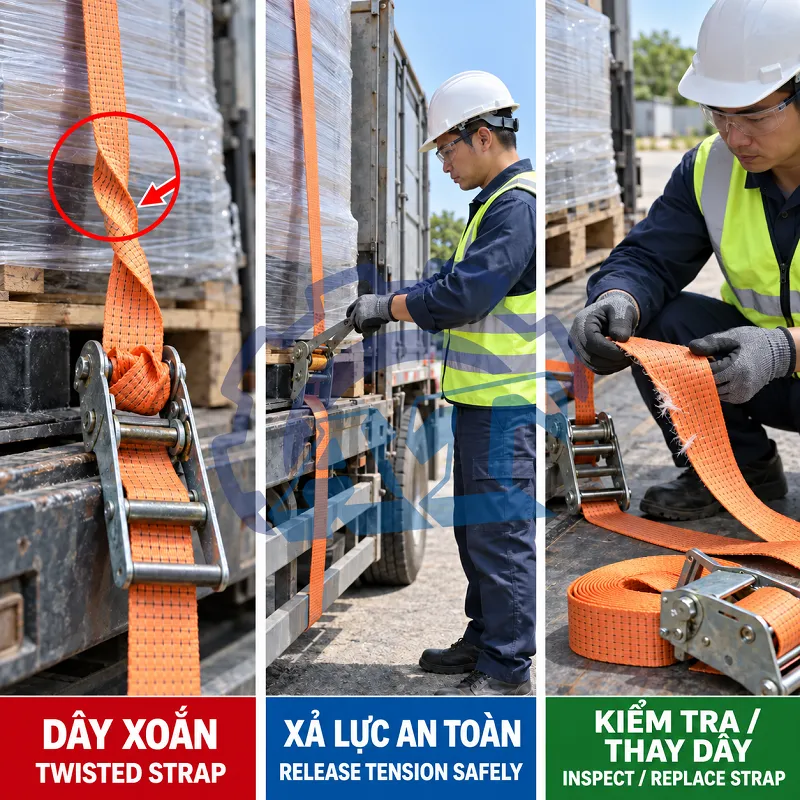
Twisted strap, safe tension release and strap inspection.
The Safety Risks of a Twisted Ratchet Strap
Under international cargo securement standards such as EN 12195-2 and WSTDA-T-1, polyester (PES) tie-down webbing is engineered to distribute tension uniformly across its entire width. When a strap twists or folds during tensioning, three mechanical issues occur:
-
Severe Edge-Load Stress: Tension shifts from the full width of the strap (e.g., 25mm, 38mm, or 50mm) onto a single outer edge. This localized load accelerates edge fraying and cuts effective breaking strength by 15% to 25%.
-
Loss of Tension During Transit: Road vibration causes twisted sections over cargo corners to slowly flatten or shift, leading to an immediate drop in pre-tension force (TF) and unstable cargo.
-
Ratchet Spool Jamming: Twisted webbing wraps unevenly inside the ratchet mandrel (spindle), pinching the strap against the frame and making it difficult or unsafe to release.
| Performance Factor | Flat, Properly Tensioned Strap | Twisted or Folded Strap |
| Load Distribution | 100% uniform across webbing width | Concentrated on a single outer edge |
| Effective Strength (WLL) | 100% of rated Lashing Capacity (LC) | Reduced by 15% – 25%+ |
| Corner Abrasion Resistance | High (full surface contact) | Low (rapid fraying along the raised edge) |
| Ratchet Release | Smooth, predictable operation | Prone to spool binding and jamming |
| Vibration Stability | Holds pre-tension during transit | Loses tension as twists settle |
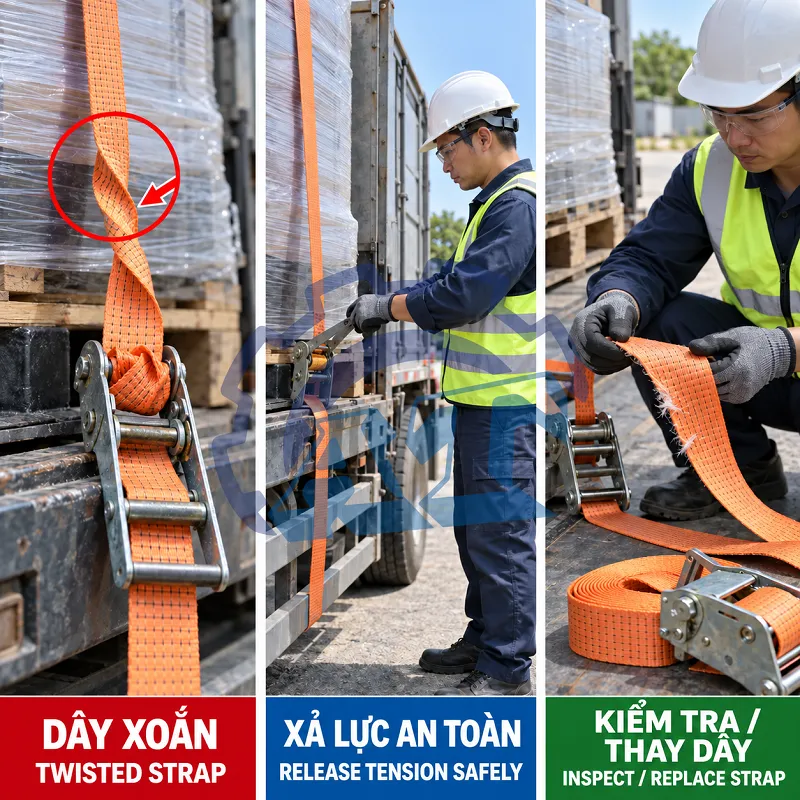
Twisted strap, safe tension release and strap inspection.
Read our guide to learn more about WLL, LC and Breaking Strength
5 Common Causes of Strap Twisting
-
Skewed Threading in the Mandrel: Inserting the webbing into the ratchet slot at an angle causes one side of the strap to pull tighter than the other with every crank.
-
Ratcheting With Excess Slack: Cranking the handle before pulling the strap hand-tight causes excess webbing to overlap and slip off-center inside the spool.
-
Misaligned Anchor Hooks: Attaching J-hooks, S-hooks, or flat hooks at an oblique angle creates rotational torque that travels up the strap as tension increases.
-
Uneven Corner Friction: Tightening a strap over rough wood, sharp metal edges, or high-friction surfaces without corner protectors can catch one edge of the webbing while the other slides forward.
-
Degraded Webbing ("Strap Memory"): Low-density webbing or straps stored coiled while twisted develop permanent fiber stretching along one edge, causing the strap to curl under load.
How to Tighten a Cargo Strap Without Twisting (5 Steps)
-
Flatten the Webbing First: Run your hand from the anchor point to the load to clear any twists or loops before threading the ratchet.
-
Align the Hooks With the Load Path: Attach both hooks so they sit flat against the anchor points and pull in a straight vertical or diagonal line.
-
Thread the Mandrel Squarely: Insert the loose end straight through the ratchet slot so both edges of the webbing sit flush against the inner walls of the spool.
-
Pull Out All Hand Slack: Hold the strap flat against the cargo with one hand and pull the free tail firmly with the other until the webbing lies taut across the load.
-
Apply 1.5 to 3 Spool Wraps: Crank the ratchet handle smoothly. Properly tensioned webbing requires between 1.5 and 3 full wraps around the mandrel - fewer than 1.5 wraps can slip, while more than 3 wraps cause bunching and twisting.
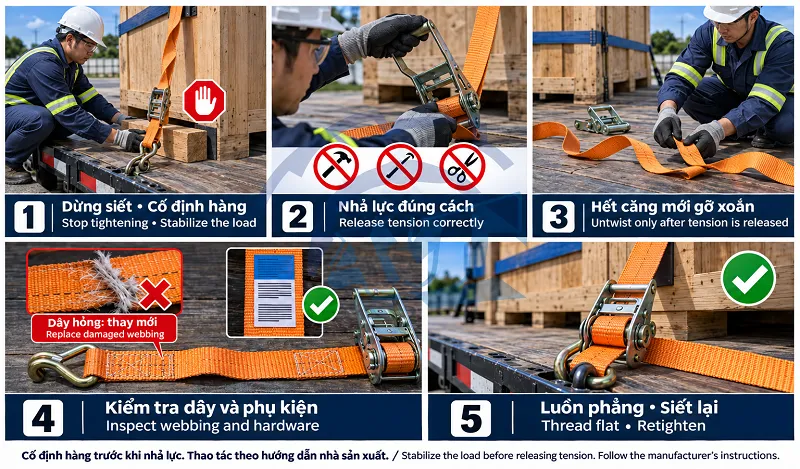
How to handle a twisted ratchet strap.
How to Release a Jammed Ratchet Caused by Twisted Webbing
If a twisted strap binds inside the ratchet drum:
-
Unlock the Mechanism Fully: Pull the release pawl back and open the ratchet handle completely to the 180-degree flat position until it locks open.
-
Pull Counter to the Twist: Do not pry the webbing with sharp tools like screwdrivers, which sever load-bearing fibers. Instead, pull firmly along the main strap line at a slight angle opposite the fold to free the pinched edge.
-
Inspect Before Reuse: Check the freed section for cut edges, broken stitching, or crushed fibers. Replace the strap immediately if structural damage is visible.
Frequently Asked Questions (FAQ)
Is it safe to put a half-twist in a strap to stop wind vibration?
No. While some drivers twist long spans of webbing to reduce wind noise ("strap hum"), safety regulations such as EN 12195-2 and CVSA guidelines require straps to lie completely flat over cargo corners and inside the ratchet spool. To stop vibration without losing strength, use corner protectors or secure the loose tail end.
Why does my cargo strap keep rolling to one side of the ratchet?
A strap rolls to one side when the ratchet is not aligned straight between the two anchor points, or when low-density webbing lacks reinforced edges. Using industrial-grade, high-tenacity polyester straps with reinforced woven edges prevents lateral curling under high tension.
Looking for High-Tenacity, Anti-Twist Cargo Lashing Straps?
At An Thanh Tech, we manufacture and supply industrial cargo lashing straps engineered with high-density polyester webbing and precision-aligned ratchet hardware that meets EN 12195-2 safety standards. Contact our team today for technical consultation and bulk quotes tailored to your freight securement needs.
Related News

15/10
2026
Match a ratchet buckle, webbing, and hooks across four criteria: webbing width, complete-assembly load rating (WLL/LC), operating environment, and anchor-point geometry. Pair the buckle to the webbing’s exact width and thickness, rate the assembly by its weakest link, and ensure hooks seat fully without tip loading.

15/10
2026
Understanding ratchet buckle load ratings is essential for safe cargo securement. This guide explains the difference between WLL (Working Load Limit), LC (Lashing Capacity) and breaking strength, shows how to read a ratchet strap label, and helps buyers select the correct ratchet buckle assembly for US, EU and Australian transport applications.

01/11
2026
Dirt, moisture and worn parts can reduce a cam buckle’s grip. In this guide, An Thanh Tech, a cargo securing hardware manufacturer in Ho Chi Minh City, Vietnam, shares practical cam buckle strap maintenance tips, from cleaning and inspection to storage and replacement.

01/11
2026
Ratchet strap slipping or jamming? Learn how to thread, tighten and release a ratchet buckle correctly with practical safety guidance from An Thanh Tech, a cargo securing hardware manufacturer in Vietnam.
View more