

FIFO vs. LIFO: Definitions, Formulas, Examples & Warehouse Guide
- The Inventory Management Dilemma: Choosing FIFO or LIFO?
- Core Concepts: What Are the FIFO and LIFO Methods?
- Detailed Comparison: FIFO vs. LIFO Side-by-Side
- Formulas & Step-by-Step Calculation Examples
- Real-World Scenario
- 1. Calculation Using FIFO (First-In, First-Out)
- 2. Calculation Using LIFO (Last-In, First-Out)
- Summary of Financial Impact (Q1 Results)
- Advantages and Disadvantages of FIFO and LIFO
- Practical Warehouse Execution: Aligning Racking & Load Securement with FIFO/LIFO
- Frequently Asked Questions (FAQ)
FIFO (First-In, First-Out) and LIFO (Last-In, First-Out) are two core methods for inventory valuation and warehouse stock rotation. While FIFO moves the oldest stock first to prevent obsolescence and reflect current balance sheet value, LIFO expenses the newest stock first to reduce taxable income during inflation. Discover their key differences, COGS formulas, step-by-step math examples, and pallet racking tips.
FIFO (First-In, First-Out) and LIFO (Last-In, First-Out) are two foundational cost flow assumptions used to value inventory and calculate the Cost of Goods Sold (COGS) in accounting and warehouse logistics. While FIFO dispatches the oldest stock first to mirror physical rotation, LIFO expenses the newest stock first to lower taxable income during inflation - two core principles An Thanh Tech helps businesses optimize in modern warehousing.
The Inventory Management Dilemma: Choosing FIFO or LIFO?
Selecting between FIFO and LIFO directly impacts two critical areas of your business: financial reporting accuracy and physical warehouse efficiency.
In accounting, raw material and finished goods prices fluctuate across purchasing batches. When a company sells 100 units from a warehouse holding 500 units purchased at three different price points, finance teams need a consistent rule to determine which unit cost moves to the income statement (COGS) and which stays on the balance sheet (Ending Inventory). Simultaneously, warehouse operations managers must align physical pallet storage and picking workflows to prevent stock deterioration, damaged packaging, and bottlenecks.
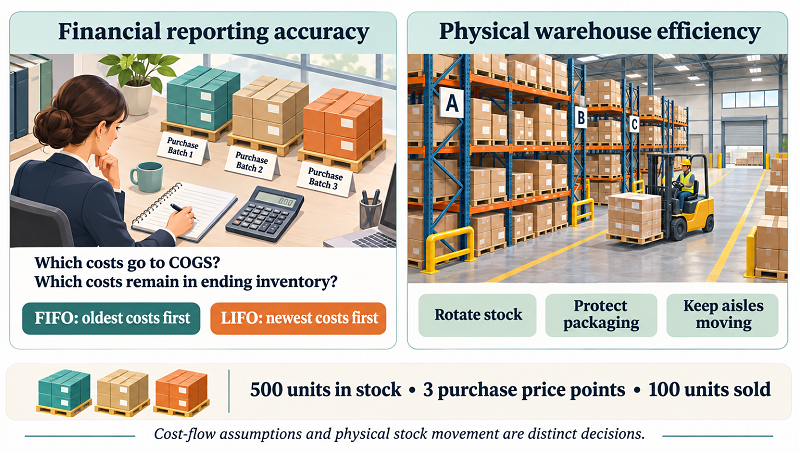
Choosing FIFO or LIFO for inventory costing and warehouse efficiency.
Core Concepts: What Are the FIFO and LIFO Methods?
1. What Is FIFO (First-In, First-Out)?
FIFO (First-In, First-Out) is an inventory valuation and warehouse management method where the first goods purchased or manufactured are the first goods sold, consumed, or shipped.
-
Accounting Logic: The cost of the oldest inventory batch is assigned to COGS first, leaving the most recently purchased inventory costs on the balance sheet.
-
Warehouse Execution: Pallets and cartons enter the storage system from an in-feed aisle and are picked from the opposite retrieval face, ensuring no batch sits stagnant in deep storage.
-
Best Industries for FIFO: Food and beverage, pharmaceuticals, cosmetics, electronics, chemical manufacturing, and export logistics.
2. What Is LIFO (Last-In, First-Out)?
LIFO (Last-In, First-Out) is an inventory valuation method where the most recently purchased or produced goods are recorded as the first ones sold or dispatched.
-
Accounting Logic: The cost of the newest inventory batch is expensed to COGS first, while the oldest batch costs remain in Ending Inventory.
-
Warehouse Execution: In physical warehousing, LIFO is applied when products are loaded and retrieved from the exact same aisle face (such as Drive-In racking or bulk floor stacking), where new pallets block access to older pallets behind them.
-
Best Industries for LIFO: Non-perishable bulk commodities, coal, sand, gravel, building materials, heavy metal components, and US-based retail or petrochemical companies optimizing for tax deferral under US GAAP.
Detailed Comparison: FIFO vs. LIFO Side-by-Side
The table below outlines the operational, financial, and regulatory differences between FIFO and LIFO during normal inflationary market conditions (rising prices):
| Comparison Criteria | FIFO (First-In, First-Out) | LIFO (Last-In, First-Out) |
| Order of Cost Flow | Oldest inventory costs expensed first | Newest inventory costs expensed first |
| Cost of Goods Sold (COGS) | Lower (uses older, cheaper batch costs) | Higher (uses newer, higher batch costs) |
| Ending Inventory Value | Higher (reflects current market replacement cost) | Lower (valued at historical, outdated prices) |
| Net Income / Reported Profit | Higher during inflation | Lower during inflation |
| Income Tax Liability | Higher tax burden due to higher reported profit | Lower tax burden (acts as an inflation tax shield) |
| Accounting Standards | Permitted globally (IFRS & US GAAP) | Permitted under US GAAP; Prohibited under IFRS (IAS 2) |
| Physical Stock Obsolescence | Minimal risk; continuous stock rotation | High risk for perishable or time-sensitive goods |
| Record-Keeping Complexity | Easy to track and audit across batch layers | Complex; requires tracking LIFO layers and LIFO reserve |
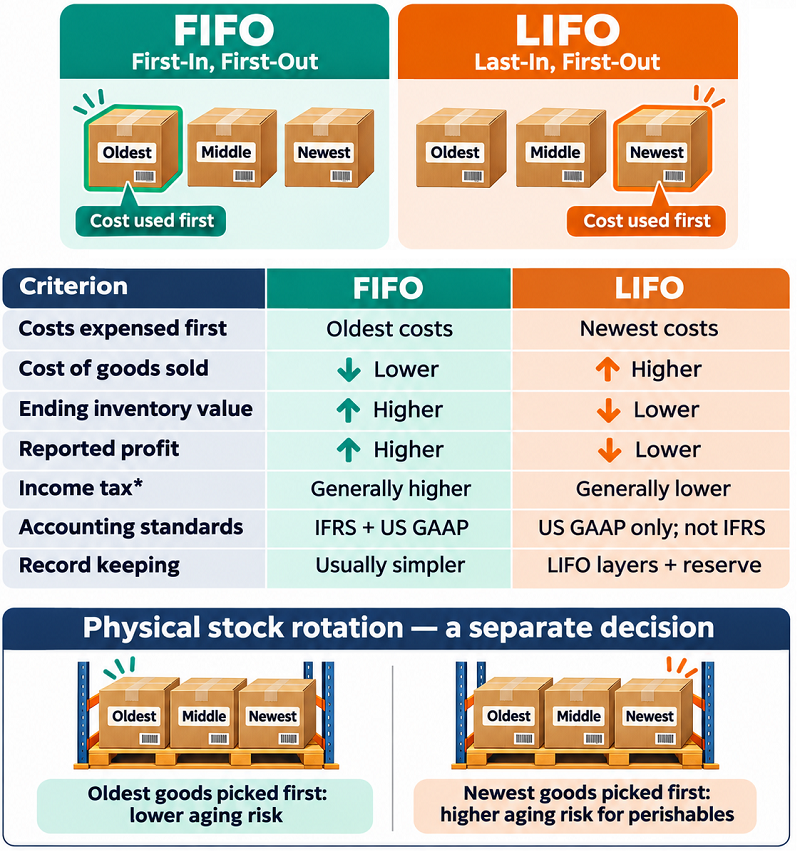
FIFO vs. LIFO comparison of inventory costs, profits, accounting standards and stock rotation during rising prices.
Formulas & Step-by-Step Calculation Examples
Both FIFO and LIFO rely on the fundamental inventory accounting formulas connecting Cost of Goods Sold (COGS) and Ending Inventory:
Formula 1: Cost of Goods Sold (COGS)
COGS = Beginning Inventory + Purchases During Period − Ending Inventory
Formula 2: Ending Inventory
Ending Inventory = Total Cost of Goods Available for Sale − COGS
Real-World Scenario
Assume a logistics supply distributor purchases three batches of reusable PVC pallet wraps during Q1:
-
Batch 1 (January 5): 100 units × $10 per unit = $1,000
-
Batch 2 (February 12): 150 units × $12 per unit = $1,800
-
Batch 3 (March 20): 100 units × $15 per unit = $1,500
-
Total Units Available for Sale: 100 + 150 + 100 = 350 units
-
Total Cost of Goods Available for Sale: $1,000 + $1,800 + $1,500 = $4,300
During Q1, the distributor sells 220 units, leaving 130 units in Ending Inventory (350 − 220 = 130 units).
1. Calculation Using FIFO (First-In, First-Out)
Under FIFO, we pull the 220 sold units starting from the oldest batch (Batch 1) and move forward chronologically:
-
Step 1 — Take all 100 units from Batch 1: 100 units × $10 = $1,000
-
Step 2 — Take the remaining 120 units from Batch 2: 120 units × $12 = $1,440
-
Step 3 — Calculate FIFO COGS:FIFO COGS = $1,000 + $1,440 = $2,440
-
Step 4 — Calculate FIFO Ending Inventory (130 units remaining):
-
30 remaining units from Batch 2: 30 units × $12 = $360
-
100 untouched units from Batch 3: 100 units × $15 = $1,500
-
FIFO Ending Inventory = $360 + $1,500 = $1,860
-
2. Calculation Using LIFO (Last-In, First-Out)
Under LIFO, we pull the 220 sold units starting from the newest batch (Batch 3) and move backward:
-
Step 1 — Take all 100 units from Batch 3: 100 units × $15 = $1,500
-
Step 2 — Take the remaining 120 units from Batch 2: 120 units × $12 = $1,440
-
Step 3 — Calculate LIFO COGS:LIFO COGS = $1,500 + $1,440 = $2,940
-
Step 4 — Calculate LIFO Ending Inventory (130 units remaining):
-
100 untouched units from Batch 1: 100 units × $10 = $1,000
-
30 remaining units from Batch 2: 30 units × $12 = $360
-
LIFO Ending Inventory = $1,000 + $360 = $1,360
-
Summary of Financial Impact (Q1 Results)
| Financial Metric | FIFO Result | LIFO Result | Variance / Impact |
| Units Sold | 220 units | 220 units | Identical physical volume |
| Cost of Goods Sold (COGS) | $2,440 | $2,940 | LIFO COGS is $500 higher |
| Ending Inventory (130 units) | $1,860 | $1,360 | FIFO Inventory is $500 higher |
| Total Accounted Value | $4,300 | $4,300 | 100% Reconciled |
Advantages and Disadvantages of FIFO and LIFO
Pros and Cons of FIFO
-
Advantages:
-
Universal Compliance: Accepted under both IFRS and US GAAP, simplifying cross-border financial consolidation.
-
Accurate Balance Sheet: Ending inventory closely reflects current market replacement value.
-
Reduced Waste: Aligns with physical warehouse rotation, cutting spoilage and dead stock.
-
-
Disadvantages:
-
Higher Tax Burden in Inflation: Matching older, lower costs against current higher selling prices inflates paper profits-often called "inventory phantom profit" - resulting in higher corporate income tax.
-
Pros and Cons of LIFO
-
Advantages:
-
Tax Deferral in Rising Markets: Matches current high acquisition costs against current revenues, lowering taxable net income during inflationary cycles.
-
Less Price Volatility on Income Statement: Gross margins reflect real-time replacement costs.
-
-
Disadvantages:
-
Global Regulatory Ban: Prohibited under IFRS (IAS 2) and international-converged accounting frameworks, limiting its use primarily to US GAAP entities.
-
Balance Sheet Distortion: Understates ending inventory value using decades-old unit costs.
-
LIFO Liquidation Risk: If inventory levels drop and old, cheap LIFO layers are sold off, taxable profits spike unexpectedly.
-
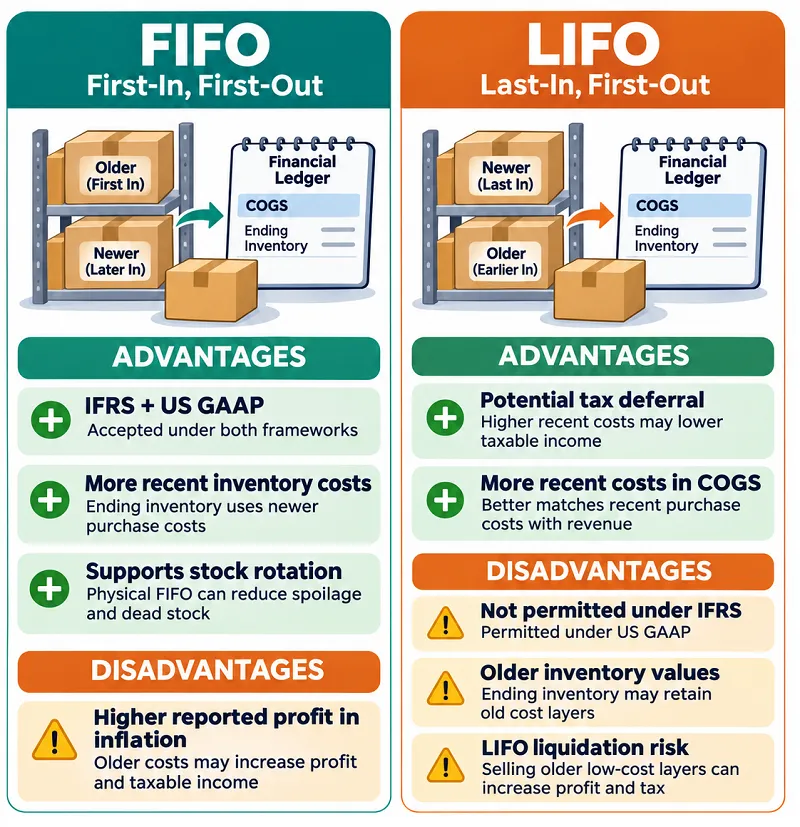
Advantages and disadvantages of FIFO and LIFO for inventory valuation, tax and stock rotation.
Practical Warehouse Execution: Aligning Racking & Load Securement with FIFO/LIFO
In real-world supply chain operations, an inventory method is only as effective as the physical warehouse infrastructure supporting it.
-
Racking Systems for FIFO Execution:
-
Pallet Flow Racking (Gravity Flow): Pallets are loaded at the higher end of inclined roller tracks and glide smoothly to the picking face.
-
Selective & Drive-Through Racking: Forklifts can access every pallet position directly or load from one side and pick from the other.
-
-
Racking Systems for LIFO Execution:
-
Drive-In & Push-Back Racking: Designed for high-density storage of homogeneous, non-perishable SKUs where forklifts load and unload from a single aisle face.
-
-
Unit Load Stability in High-Turnover FIFO Flows:
-
Because FIFO requires frequent pallet shifting, gravity movement, and multi-stage handling, unstable loads cause warehouse accidents and damaged SKU batches.
-
Replacing single-use plastic stretch film with reusable PVC pallet wrap nets and heavy-duty ratchet tie-down straps (such as An Thanh Tech's industrial cargo securing solutions) keeps palletized loads locked in place during gravity flow transitions while allowing 100% barcode scanning and ventilation for FIFO batch tracking.
-
Frequently Asked Questions (FAQ)
Why is LIFO banned under IFRS?
The International Accounting Standards Board (IASB) prohibited LIFO under IAS 2 (Inventories) because LIFO distorts the balance sheet by reporting ending inventory at outdated historical costs rather than recent market values, and allows earnings manipulation through intentional LIFO layer liquidations.
What is the difference between FIFO and FEFO?
While FIFO (First-In, First-Out) dispatches stock based on the chronological date it entered the warehouse, FEFO (First-Expired, First-Out) dispatches stock based on the earliest expiration date printed on the batch-even if that batch arrived more recently. FEFO is critical in pharmaceuticals, fresh produce, and chemical storage.
Can a company switch from LIFO to FIFO?
Yes, companies can transition from LIFO to FIFO, though doing so requires retrospective restatement of financial statements and regulatory approval from tax authorities (such as filing IRS Form 3115 in the United States) to account for the accumulated LIFO reserve.
Which inventory method is better during inflation?
From a cash-flow and tax minimization perspective (where legally permitted under US GAAP), LIFO is advantageous during inflation because it increases COGS and reduces taxable income. From an investor valuation, creditworthiness, and international compliance perspective, FIFO is superior because it presents a stronger balance sheet and higher net profitability.
Related News

14/11
2026
Mechanical engineering manufacturing is one of the fundamental engineering disciplines driving the development of modern industry. Almost every product and piece of equipment used in manufacturing, from industrial machinery and automotive components to agricultural equipment and everyday consumer goods, relies on mechanical manufacturing technologies at some stage of its production.

09/11
2026
Knowing how to clean and store tie-down straps properly prevents webbing wear, stops ratchet rust, and ensures safe cargo transport. Follow these 3 simple steps to wash, dry, and store your straps for maximum longevity.

07/11
2026
Think all industrial greys look the same? Place RAL 7032 (Pebble Grey) next to RAL 7035 (Light Grey), and the contrast between warm beige-grey and bright silver-grey is unmistakable. Explore their exact color codes, powder coating specs, and ideal applications below to choose the right finish.

15/10
2026
Match a ratchet buckle, webbing, and hooks across four criteria: webbing width, complete-assembly load rating (WLL/LC), operating environment, and anchor-point geometry. Pair the buckle to the webbing’s exact width and thickness, rate the assembly by its weakest link, and ensure hooks seat fully without tip loading.
View more