

Ratchet Buckle vs. Cam Buckle: Specs, Load Limits & Guide
- Ratchet Buckle vs. Cam Buckle: Key Differences
- What Is a Cam Buckle & When to Use It?
- What Is a Ratchet Buckle & How It Works?
- Cargo Securement Standards (EN 12195-2)
- 1. Frictional vs. Direct Lashing (STF vs. LC)
- 2. Safety Factor Ratios (WLL vs. MBS)
- 3. The 1.5 to 3 Mandrel Wraps Rule
- 4. Webbing Material & Anti-Corrosion Coating
- 5 Steps to Choose the Right Tie-Down Buckle
- Real-World Industrial Case Studies
- 2026 Product Catalog & B2B Pricing
- Frequently Asked Questions (FAQ)
Choosing the wrong cargo strap risks shifted machinery, damaged freight, and costly transit delays. So, ratchet buckle vs. cam buckle - which one do you need? While cam buckles offer quick, crush-free strapping for loads under 500 kg, ratchet buckles generate 10x more tension to lock 1 to 5-ton cargo per EN 12195-2 standards. Compare load limits, specs, and factory pricing below in just 3 minutes.
Quick Answer (Executive Summary):
The primary difference between a ratchet buckle and a cam buckle is the tensioning mechanism and load capacity. Cam buckles use a spring-loaded friction clamp tensioned by hand for light loads under 500 kg (Standard Tension Force: 25 to 50 daN). Ratchet buckles use a mechanical gear-and-pawl lever to multiply tension for heavy loads from 1,000 kg to 5,000+ kg (Standard Tension Force: 150 to 500+ daN). Use cam buckles for fast, crush-free securing of fragile goods, and ratchet buckles for highway freight, ocean containers, and industrial machinery.
Key Takeaways for Procurement & Fleet Managers:
- Load Threshold: 500 kg is the strict engineering dividing line. Below 500 kg, cam buckles optimize speed and cost; above 500 kg, ratchet buckles are mandatory for road safety.
- Tensioning Physics: A standard ratchet buckle generates up to 10 times more downward clamping force (STF) than a manually pulled cam buckle.
- Fragile Cargo Protection: Cam buckles prevent over-tightening through direct tactile feedback, eliminating crushed cartons or deformed plastic enclosures.
- Safety Compliance: Industrial tie-down hardware must maintain a 2:1 or 3:1 Safety Factor between Working Load Limit (WLL) and Minimum Breaking Strength (MBS) per EN 12195-2.
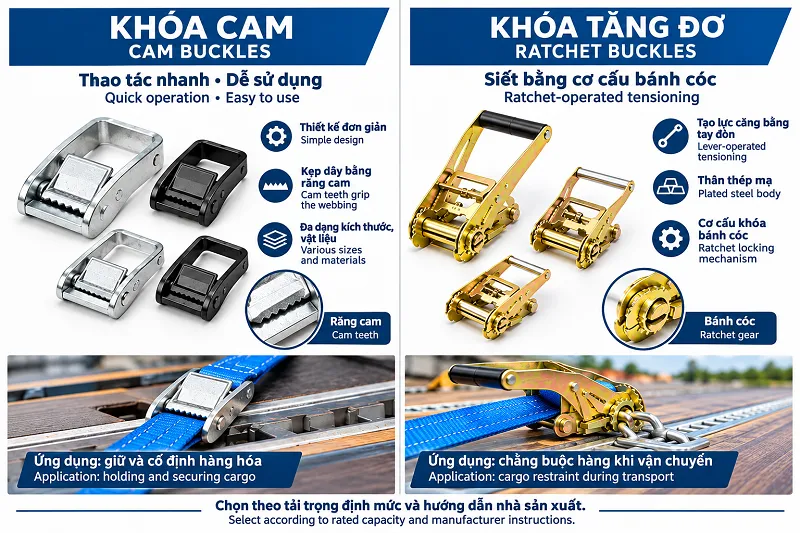
Cam buckles and ratchet buckles for cargo securing
Ratchet Buckle vs. Cam Buckle: Key Differences
A cam buckle relies on manual pull force and a spring-loaded serrated cam to hold webbing in place, whereas a ratchet buckle uses a geared spool and lever handle to mechanically multiply tension and lock the webbing against dynamic shock loads.
| Technical & Commercial Metric | Cam Buckle (Light-Duty) | Ratchet Buckle (Heavy-Duty) |
|---|---|---|
| Tensioning Mechanism | Manual hand pull + spring-loaded friction cam | Mechanical lever + gear wheel & locking pawl |
| Working Load Limit (WLL) | 250 kg - 500 kg | 1,000 kg - 5,000 kg (1 - 5 Tons) |
| Standard Tension Force (STF) | 25 daN - 50 daN (approx. 25 - 50 kgf) | 150 daN - 500+ daN (approx. 150 - 500+ kgf) |
| Webbing Widths Available | 25 mm, 35 mm, 38 mm, 50 mm | 25 mm, 35 mm, 38 mm, 50 mm, 75 mm |
| Primary Material | Die-cast Zinc Alloy (Zamak) / Stamped Steel | Heat-treated Carbon Steel (AISI 1045 / Q235) / Stainless Steel 304 |
| Operation Time (Strap & Release) | 5 - 10 seconds per buckle | 20 - 30 seconds per buckle |
| Risk of Over-Tensioning | None (Safe for fragile/compressible goods) | High (Can crush hollow or delicate cargo) |
| Reference Unit Price (Vietnam) | 30,000 - 80,000 VND (~$1.20 - $3.20 USD) | 150,000 - 500,000+ VND (~$6.00 - $20.00+ USD) |
| Optimal Applications | Motorbikes, warehouse pallets, kayaks, electronics | Flatbed trucks, sea containers, CNC machinery, steel coils |
What Is a Cam Buckle & When to Use It?
A cam buckle is a single-piece quick-release fastener that secures webbing through a spring-actuated, toothed rotating cam. When an operator presses the thumb lever, the cam teeth disengage, allowing the polyester or polypropylene webbing to be threaded and pulled tight by hand. Releasing the lever causes the internal torsion spring to clamp the serrated cam onto the strap; any pull from the cargo increases the wedging grip on the teeth.
Cam Buckle Technical Specs & Limits
- Rated Capacity (WLL): Standardized between 250 kg and 450 kg (maximum 500 kg).
- Hand Force Limitation: Governed by Standard Hand Force (SHF) of 50 daN. Because there is no mechanical leverage, pre-tension rarely exceeds 50 daN.
- Operational Advantages: Weighs 60% less than a ratchet assembly, operates one-handed in 5 to 10 seconds, and costs up to 75% less per unit.
- Failure Modes to Avoid: Subjecting a cam buckle to severe highway vibration or loads above 500 kg can cause webbing creep (gradual slippage through the cam teeth) or shear failure of the zinc-alloy cam pin.
Shop the product here: Cam buckle Tie down
What Is a Ratchet Buckle & How It Works?
A ratchet buckle is a high-tensile mechanical tensioning device engineered to secure multi-ton freight on commercial vehicles, flatbeds, and ocean containers. It consists of a stamped steel frame, a slotted center winding mandrel (spool), dual ratchet gear wheels, a spring-loaded locking pawl, and an ergonomic lever handle.
Ratchet Buckle Technical Specs & Limits
- Rated Capacity (WLL): Ranges from 1,000 kg (1 ton) for 25 mm straps up to 5,000 kg (5 tons) for 50 mm straps, and 10,000 kg (10 tons) for 75 mm - 100 mm heavy-haulage assemblies.
- Mechanical Advantage: Pumping the lever handle converts a 50 daN hand input into 150 daN to 500+ daN of Standard Tension Force (STF).
- Positive Mechanical Lock: Once the handle is folded flat into the locked position, the sliding pawl physically blocks the gear teeth, making accidental slippage under dynamic braking or road shock virtually impossible.
- Operational Trade-Offs: Requires 20 to 30 seconds per tie-down point and demands operator awareness to avoid crushing soft packaging.
Buy the product here: Ratchet buckle
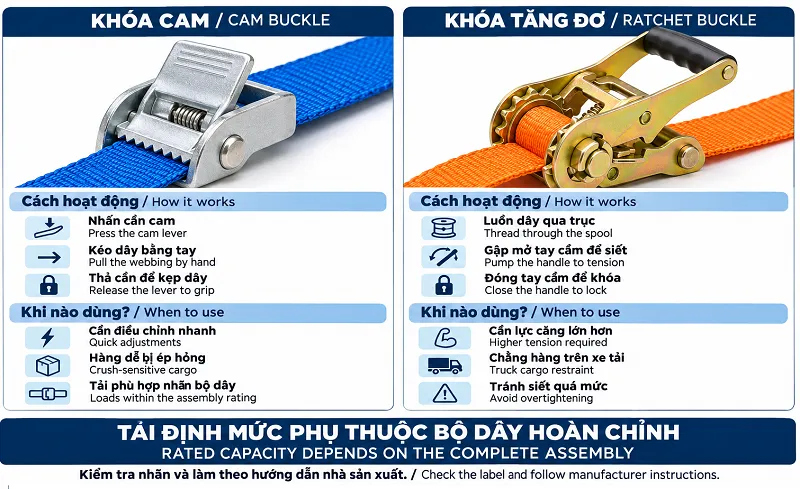
Cam buckles vs. ratchet buckles: operation and applications
Cargo Securement Standards (EN 12195-2)
To comply with international transport safety regulations (EN 12195-2 in Europe/Asia and WSTDA-T-1 in North America), logistics engineers evaluate four technical parameters before specifying tie-down hardware:
1. Frictional vs. Direct Lashing (STF vs. LC)
- Frictional (Top-Over) Lashing: The strap passes over the top of the cargo to press it down onto the truck bed. During emergency braking, forward inertia can reach 0.8g (80% of cargo weight). Only a ratchet buckle generates sufficient downward Standard Tension Force (STF) to multiply deck friction and prevent load sliding.
- Direct Lashing: Straps connect directly to anchor points on the cargo at opposing angles. Here, the buckle's Lashing Capacity (LC / WLL) and end-fittings (Double J-hooks, Flat hooks, or D-rings) carry the direct tensile load.
2. Safety Factor Ratios (WLL vs. MBS)
Never confuse Minimum Breaking Strength (MBS) with Working Load Limit (WLL). Under EN 12195-2, metallic hardware and webbing assemblies follow a strict calculation formula:
Working Load Limit (WLL) = Minimum Breaking Strength (MBS) / Safety Factor (SF)
The standard Safety Factor (SF) is 2:1 for complete lashing assemblies and 3:1 for standalone webbing. For example, a ratchet strap tested at a 3,000 kg breaking strength has a safe Working Load Limit of 1,000 kg to 1,500 kg.
3. The 1.5 to 3 Mandrel Wraps Rule
Improper threading is the leading cause of ratchet buckle failure on the road:
- Pull all webbing slack completely tight through the mandrel slot by hand before ratcheting.
- Pump the handle until the spool accumulates strictly 1.5 to 3 full wraps of webbing.
- Why it matters: Fewer than 1.5 wraps lacks sufficient surface friction on the mandrel, risking webbing slippage at the slot. More than 3 wraps overfills the spool, reduces lever torque, and prevents the locking pawl from fully engaging the gear teeth.
4. Webbing Material & Anti-Corrosion Coating
- Webbing Selection: Always specify 100% High-Tenacity Polyester (PES) for industrial ratchet and cam straps. PES exhibits low elongation (less than 7% stretch at WLL) and retains full strength when wet. Avoid Nylon (Polyamide) for rigid freight, as it stretches up to 20% and slackens in humid conditions.
- Corrosion Coatings: Specify Zinc-Plated (Bichromate Gold Passivation) steel for dry enclosed freight, or AISI 304 Stainless Steel / Hot-Dip Galvanized ratchet buckles for marine, coastal, and outdoor chemical environments.
5 Steps to Choose the Right Tie-Down Buckle
Use this 5-question audit to standardize procurement across your warehouse or transport fleet:
- What is the unit weight of the cargo?
Under 500 kg: Select a Cam Buckle (25 mm or 35 mm). | 500 kg or heavier: Select a Ratchet Buckle (38 mm, 50 mm, or 75 mm). - Is the cargo crush-sensitive or structurally rigid?
Fragile (cartons, thin plastics, electronics): Select a Cam Buckle. | Rigid (steel coils, timber, CNC machinery): Select a Ratchet Buckle. - What vehicle and transit speed are involved?
Intralogistics trolleys, motorbikes, urban delivery: Cam Buckle. | Highway trucks, flatbeds, ocean containers: Ratchet Buckle. - How frequent are loading and unloading cycles?
High-frequency multi-stop parcel drops (10+ stops/day): Cam Buckle cuts strapping time by 65%. | Long-haul transport: Ratchet Buckle. - What is the environmental exposure?
Indoor climate-controlled warehouse: Standard Zinc-Alloy Cam Buckle. | Outdoor rain, road salt, UV exposure: Galvanized or Stainless Steel Ratchet Buckle.
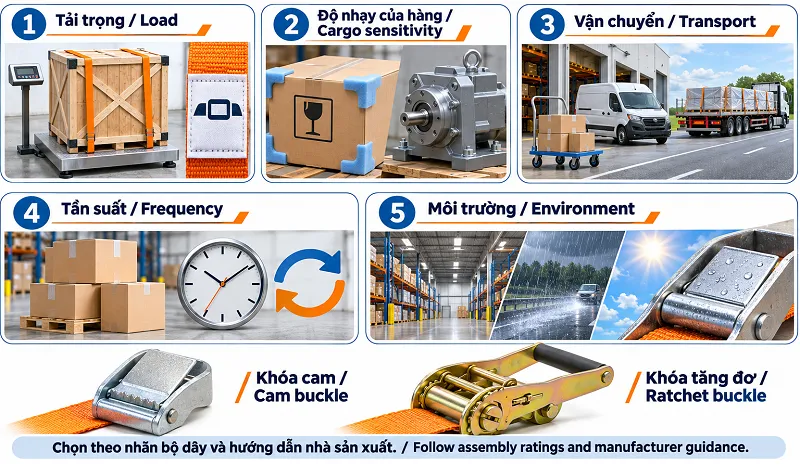
Five factors for choosing a tie-down buckle: load, cargo sensitivity, transport, frequency and environment.
Real-World Industrial Case Studies
Case Study 1: Heavy Machinery Logistics
- Challenge: A Ho Chi Minh City freight operator transporting 2.2-ton mechanical presses experienced frequent load shifting on uneven national highways when drivers used light-duty friction straps.
- Solution: Upgraded fleet securement to An Thanh Tech 50 mm Ratchet Tie-Down Assemblies (WLL: 3,000 kg / MBS: 6,000 kg) paired with Double J-Hooks and high-tenacity PES webbing.
- Verified Result: Pre-tension force increased fivefold, reducing transit damage claims by 90% over a 12-month audit period.
Case Study 2: Electronics Warehouse Pallets
- Challenge: An electronics assembly plant used heavy 50 mm ratchet straps to secure 300 kg component pallets inside their warehouse. Workers frequently over-tightened the ratchets, crushing top-layer packaging boxes and wasting time during unstrapping.
- Solution: Standardized on 25 mm & 35 mm Cam Buckle Straps (WLL: 350 kg).
- Verified Result: Reduced tie-down hardware procurement spend by 40%, eliminated carton crush defects, and decreased pallet staging time by 15 seconds per pallet.
2026 Product Catalog & B2B Pricing
An Thanh Technical Co., Ltd. manufactures and supplies precision-stamped cargo control hardware with direct factory pricing in Vietnam:
In-Stock Product Lines & Reference Pricing
- Cam Buckle Series (Widths: 25 mm / 35 mm / 38 mm / 50 mm): Working Load Limit (WLL) from 250 kg to 500 kg. Factory price starting from 35,000 VND (~$1.40 USD) per unit.
- Ratchet Buckle Series (Widths: 25 mm / 35 mm / 38 mm / 50 mm / 75 mm): Working Load Limit (WLL) from 1,000 kg (1 ton) to 5,000 kg (5 tons). Compatible with Double J-Hooks, U-Hooks, Flat Hooks, S-Hooks, and D-Rings. Factory price starting from 180,000 VND (~$7.20 USD) per assembly.
- B2B Promotional Policy: Order 10 assemblies and receive 2 complimentary S-Hooks or subsidized intra-city freight delivery. Bulk orders of 50+ units qualify for 5% to 15% OEM wholesale discounts.
Quality Assurance & Commercial Commitments
- Certification & Traceability: Full CO (Certificate of Origin), CQ (Certificate of Quality), and tensile load test reports provided for B2B and export projects.
- Technical Warranty: 6 to 12 months 1-for-1 replacement warranty against manufacturing defects.
- Exchange Policy: 7-day return/exchange window if hardware load ratings do not match project specifications.
- Fast Nationwide Dispatch: 24 to 48-hour delivery across Vietnam.
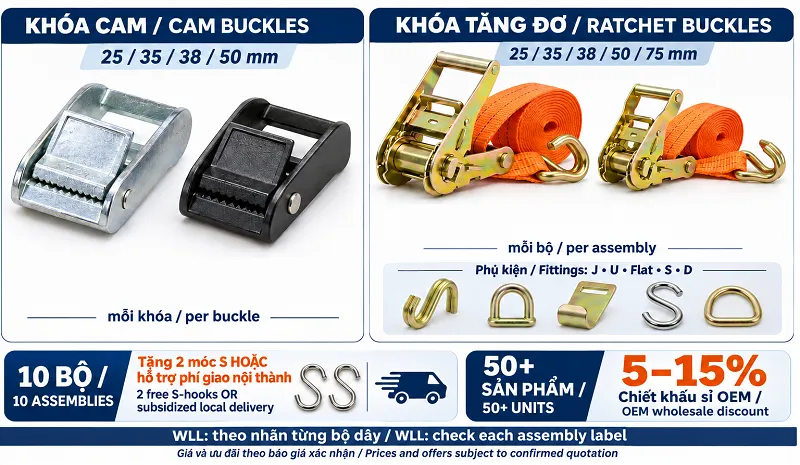
Cam buckles and ratchet buckle assemblies with factory pricing and OEM wholesale offers.
Direct Manufacturer Contact (An Thanh Technical Co., Ltd.):
Factory & Head Office: 5 Vo Van Bich Street, Binh My Commune, Ho Chi Minh City, Vietnam
Tax Identification Number: 0313201963
Hotline / Zalo (5-Minute B2B & Retail Quote): (+84) 942 127 028
Email: cokhi.anthanhtech@gmail.com
Website: https://anthanhtech.com/en
Frequently Asked Questions (FAQ)
Can a 500 kg cam buckle secure a 600 kg load?
Not based on the buckle rating alone. Suitability depends on the complete strap assembly and securing arrangement. Follow the manufacturer’s instructions and never exceed rated limits.
Why are ratchet straps typically stronger?
Ratchet straps use a lever mechanism to multiply hand force and a locking pawl to secure the spindle. Cam buckle straps rely on manual tightening and a spring-loaded cam to grip the webbing. Ratchet straps typically achieve higher tension, but load capacity depends on the complete assembly’s rating.
Are ratchet buckles hard to operate?
No. Operating a ratchet buckle takes 20 to 30 seconds in three simple steps: thread the webbing through the center mandrel slot, pull all slack tight by hand, and pump the handle 1.5 to 3 turns before folding the lever flat into the locked position.
How do you release a ratchet buckle safely?
To release a ratchet buckle, pull and hold the spring-loaded release tab (pawl latch) inside the handle while swinging the lever completely open to the 180-degree flat position. This disengages the locking pawls and allows the mandrel to spin freely so you can pull the webbing out safely.
Related News

15/10
2026
Match a ratchet buckle, webbing, and hooks across four criteria: webbing width, complete-assembly load rating (WLL/LC), operating environment, and anchor-point geometry. Pair the buckle to the webbing’s exact width and thickness, rate the assembly by its weakest link, and ensure hooks seat fully without tip loading.

15/10
2026
Understanding ratchet buckle load ratings is essential for safe cargo securement. This guide explains the difference between WLL (Working Load Limit), LC (Lashing Capacity) and breaking strength, shows how to read a ratchet strap label, and helps buyers select the correct ratchet buckle assembly for US, EU and Australian transport applications.

01/11
2026
Dirt, moisture and worn parts can reduce a cam buckle’s grip. In this guide, An Thanh Tech, a cargo securing hardware manufacturer in Ho Chi Minh City, Vietnam, shares practical cam buckle strap maintenance tips, from cleaning and inspection to storage and replacement.

01/11
2026
Ratchet strap slipping or jamming? Learn how to thread, tighten and release a ratchet buckle correctly with practical safety guidance from An Thanh Tech, a cargo securing hardware manufacturer in Vietnam.
View more