

WLL, Breaking Strength and Safety Factor Explained
Working Load Limit (WLL), Breaking Strength (BS) and Safety Factor (SF) explain how equipment’s rated working capacity relates to its failure strength. This guide covers their meanings, calculation examples and the key differences between lifting ratings and cargo lashing capacity, helping you interpret product specifications correctly.
An Thanh Tech explains three key load-rating terms: WLL (Working Load Limit) is the manufacturer’s rated working capacity under specified conditions. BS (Breaking Strength) describes failure strength, while SF (Safety Factor) expresses the relationship between the specified breaking strength and working capacity. Understanding these terms helps buyers and operators interpret product ratings correctly.
The basic relationship is:
WLL = Specified Breaking Strength ÷ Design Factor
However, this formula does not replace a manufacturer’s rating. Equipment selection must also account for the complete assembly, loading configuration and intended application.
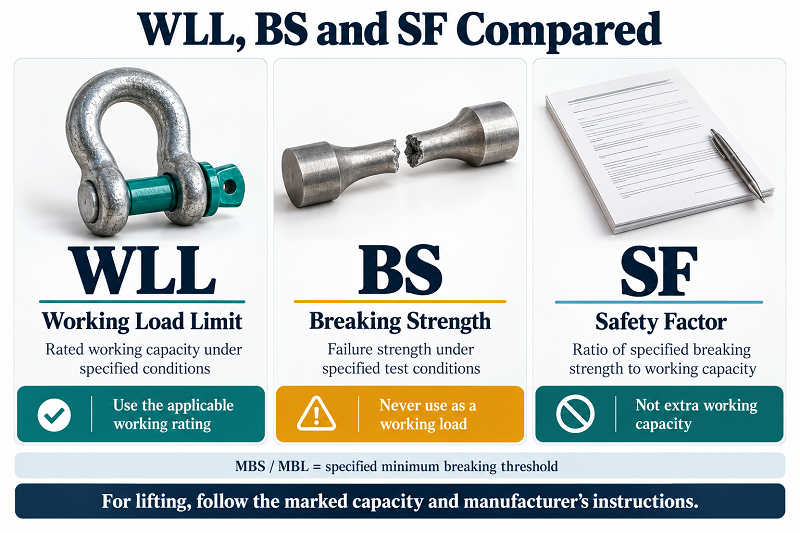
WLL, breaking strength and safety factor explained with a lifting sling, shackle and fractured tensile test specimen
What Is WLL?
Working Load Limit (WLL) is the maximum load a product is rated to support under the conditions specified by its manufacturer.
A rating may apply to an in-line pull, a particular sling hitch or a defined loading angle. Changing those conditions can change the permitted capacity.
For example, a sling marked WLL 2 tonnes for vertical lifting should not automatically be treated as having the same capacity in a choker hitch or an angled assembly. Check the rating for the configuration being used.
WLL vs SWL
SWL (Safe Working Load) also refers to a permitted working load. Its meaning and use depend on the applicable documentation and operating context.
WLL generally describes the manufacturer’s rating, while SWL may describe a limit established for a particular use. Do not assume SWL is always obsolete or that the two values must always be identical.
What Is Breaking Strength?
Breaking Strength (BS) describes the force at which an item fails during a specified test. A product datasheet may use a measured result, a nominal value or a specified strength, so the definition should be checked.
Minimum Breaking Strength (MBS) or Minimum Breaking Load (MBL) identifies a specified minimum failure threshold. It is different from the actual result obtained when an individual sample is tested.
Neither a breaking-strength claim nor an individual test result is an allowable working load.
For procurement, confirm whether the stated strength applies to:
-
Raw material, such as webbing or wire rope.
-
An individual component, such as a hook or buckle.
-
The complete finished assembly, including stitching, fittings and terminations.
A component’s breaking strength does not establish the capacity of the finished product.
What Is a Safety Factor?
A Safety Factor (SF), often called a design factor in lifting product documentation, expresses the relationship between a specified strength basis and the rated working capacity.
For a product whose rating uses minimum breaking strength:
Design Factor = MBS ÷ WLL
A 5:1 design factor means the specified minimum breaking strength is five times the working load limit, using equivalent units.
The design factor is not extra working capacity. It does not authorize overloading, shock loading or continued use of damaged equipment.
The required factor depends on the product, applicable standard and intended service. There is no single ratio suitable for every sling, shackle, hook or restraint assembly.
WLL, BS and SF Compared
| Term | Meaning | Practical use |
|---|---|---|
| WLL | Rated working capacity under specified conditions | Select equipment for its intended operating configuration |
| BS | Breaking strength, as defined in the relevant test or specification | Interpret failure-test or product-strength information |
| MBS / MBL | Specified minimum breaking threshold | Check the minimum strength requirement |
| SF / Design Factor | Ratio between the specified strength basis and working capacity | Understand the basis of the rating |
For lifting, use the applicable marked capacity - not the breaking-strength figure.
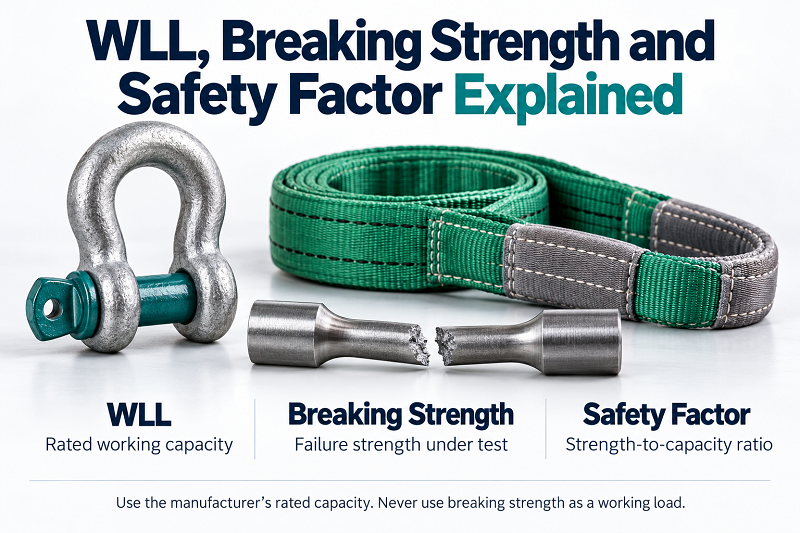
Comparison of WLL, breaking strength and safety factor for lifting equipment
How to Calculate WLL
Where the product specification defines the design factor as MBS divided by WLL, the relationship can be rearranged:
-
WLL = MBS ÷ Design Factor
-
MBS = WLL × Design Factor
-
Design Factor = MBS ÷ WLL
Use consistent units. Do not divide a strength stated in kilonewtons by a load stated in kilograms without converting them to the same basis.
Example: Calculating a Theoretical Working Load
Assume a product specification states:
| Parameter | Value |
|---|---|
| Minimum breaking strength | 100 kN |
| Design factor | 5:1 |
| Calculated working load | 20 kN |
100 kN ÷ 5 = 20 kN
This illustrates the relationship only. It does not independently certify a product for a 20 kN working load. The manufacturer must establish the rating of the finished assembly.
In particular, dividing the breaking strength of bare wire rope by a chosen factor does not establish the WLL of a fabricated wire rope sling.
How Sling Angles Affect Loading
As sling legs move farther from vertical, tension in each leg increases.
For an ideal, symmetrical two-leg arrangement with equal load sharing:
Leg tension = Total load ÷ (2 × sin θ)
Here, θ is the angle of each leg measured from the horizontal.
| Leg angle from horizontal | Approximate tension in each leg |
|---|---|
| 60° | 0.58 × total load |
| 45° | 0.71 × total load |
| 30° | 1.00 × total load |
At 30° from horizontal, each leg carries tension equal to the total suspended load, even though two legs are supporting it.
These figures explain the geometry; they are not an assembly rating chart. Actual selection must account for the centre of gravity, load distribution, hitch arrangement and manufacturer’s capacity tables.
WLL vs LC: Lifting and Cargo Lashing
Lifting equipment and cargo restraint equipment serve different purposes. A high breaking-strength figure does not make a ratchet strap suitable for lifting.
For cargo lashing straps, particularly those labelled to EN 12195-2, two important values are:
| Marking | Meaning | Main relevance |
|---|---|---|
| LC | Lashing Capacity | Capacity used in direct-lashing calculations |
| STF | Standard Tension Force | Pretension used in frictional tie-down calculations |
| BS / Breaking Force | Failure-strength information | Not a substitute for LC or STF |
LC and STF are commonly expressed in daN, a unit of force.
A label showing LC 2,500 daN does not mean that the strap can lift 2,500 kg or secure every load of that mass. Required restraint depends on the lashing method, angles, friction, anchor points and transport conditions.
Use cargo ratchet straps for load restraint and purpose-rated lifting equipment for lifting.
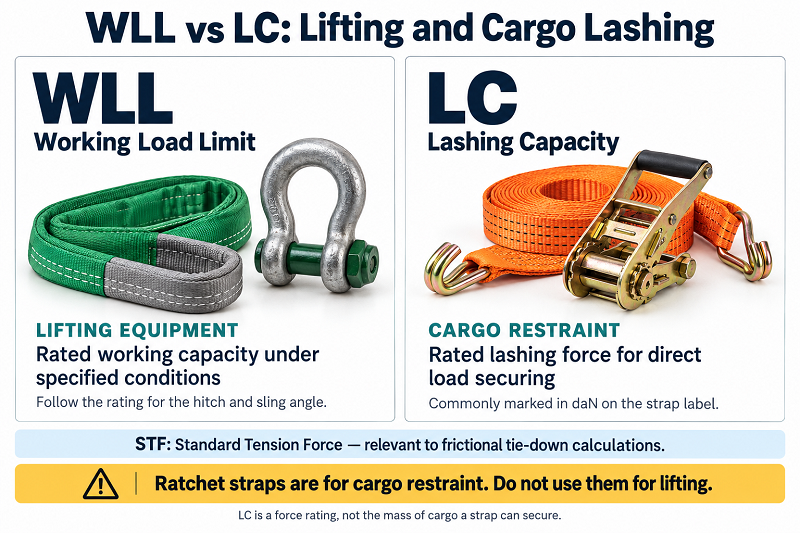
WLL vs LC for lifting and cargo lashing, with STF and lifting restriction
What to Check Before Using Rated Equipment
A readable load rating is only part of equipment selection. Before use, check:
-
Identification: Confirm the product type, manufacturer and relevant capacity marking.
-
Configuration: Match the rating to the hitch, loading direction and angle.
-
Condition: Inspect the sling, stitching, fittings and connections for damage.
-
Contact points: Provide suitable protection where edges could damage the sling.
-
Operating conditions: Follow the manufacturer’s restrictions for temperature, chemicals and loading.
Do not use a general safety factor to compensate for missing identification, visible damage or an unsuitable setup.
What to Ask a Supplier Before Buying Cargo Lashing Straps
When choosing a ratchet strap supplier, request clear product specifications covering:
-
Lashing capacity (LC) of the complete assembly.
-
Standard tension force (STF) for frictional tie-down applications.
-
Webbing width, length, material and end fittings.
-
Applicable standard, identification label and relevant test documentation.
-
Instructions for use, inspection and replacement.
For OEM enquiries with An Thanh Mechanical Services, provide your cargo type, required strap dimensions, fittings, quantity and intended lashing method. Specify any labelling or branding requirements so the quotation reflects your needs.
Compare complete assembly specifications rather than breaking strength alone. Cargo lashing straps must not be used for lifting.
Frequently Asked Questions
What is the difference between WLL and breaking strength?
WLL is the rated working capacity under specified conditions. Breaking strength concerns failure under test conditions. Equipment should be selected using its applicable working rating, not its failure strength.
Can I calculate WLL from breaking strength?
Only when the relevant strength basis and required design factor are established for that product. A calculation alone cannot replace the manufacturer’s rating or certify an unmarked assembly.
Does a 5:1 safety factor allow temporary overloading?
No. A design factor describes the relationship behind the rating. It does not increase the permitted working load.
Is a higher safety factor always better?
A higher factor alone does not establish suitability. The product must also have the correct capacity, construction, fittings and approval for the intended application.
Can I identify sling capacity by colour?
Do not rely on colour alone. Read the identification label and confirm the rating for the intended configuration.
When should equipment be removed from service?
Remove equipment from use when identification is missing or illegible, damage is found, or its condition is uncertain. Apply the inspection and rejection criteria for that specific equipment type rather than a single rule for all slings and fittings.
Related News

17/11
2026
In laser metal cutting, product accuracy depends not only on machine power and cutting speed but also on various other technical parameters. One of the key factors that is often discussed is Kerf Width, which refers to the width of the cut produced by the laser.
What is kerf width? Why does it affect machining quality? And how can this parameter be controlled to minimize dimensional deviations and optimize production efficiency? Let's explore these questions in the following article.

14/11
2026
Mechanical engineering manufacturing is one of the fundamental engineering disciplines driving the development of modern industry. Almost every product and piece of equipment used in manufacturing, from industrial machinery and automotive components to agricultural equipment and everyday consumer goods, relies on mechanical manufacturing technologies at some stage of its production.

09/11
2026
Knowing how to clean and store tie-down straps properly prevents webbing wear, stops ratchet rust, and ensures safe cargo transport. Follow these 3 simple steps to wash, dry, and store your straps for maximum longevity.

07/11
2026
Think all industrial greys look the same? Place RAL 7032 (Pebble Grey) next to RAL 7035 (Light Grey), and the contrast between warm beige-grey and bright silver-grey is unmistakable. Explore their exact color codes, powder coating specs, and ideal applications below to choose the right finish.
View more